Mira Ranks #5 Among Global AI Productivity Apps on OpenRouter
Numbers in AI are easy to manufacture. Token counts, rankings, and usage statistics get thrown around constantly - the most of them mean very little with our context. We are wary of them too, so we hold our own numbers to the same skepticism.
This one held up.
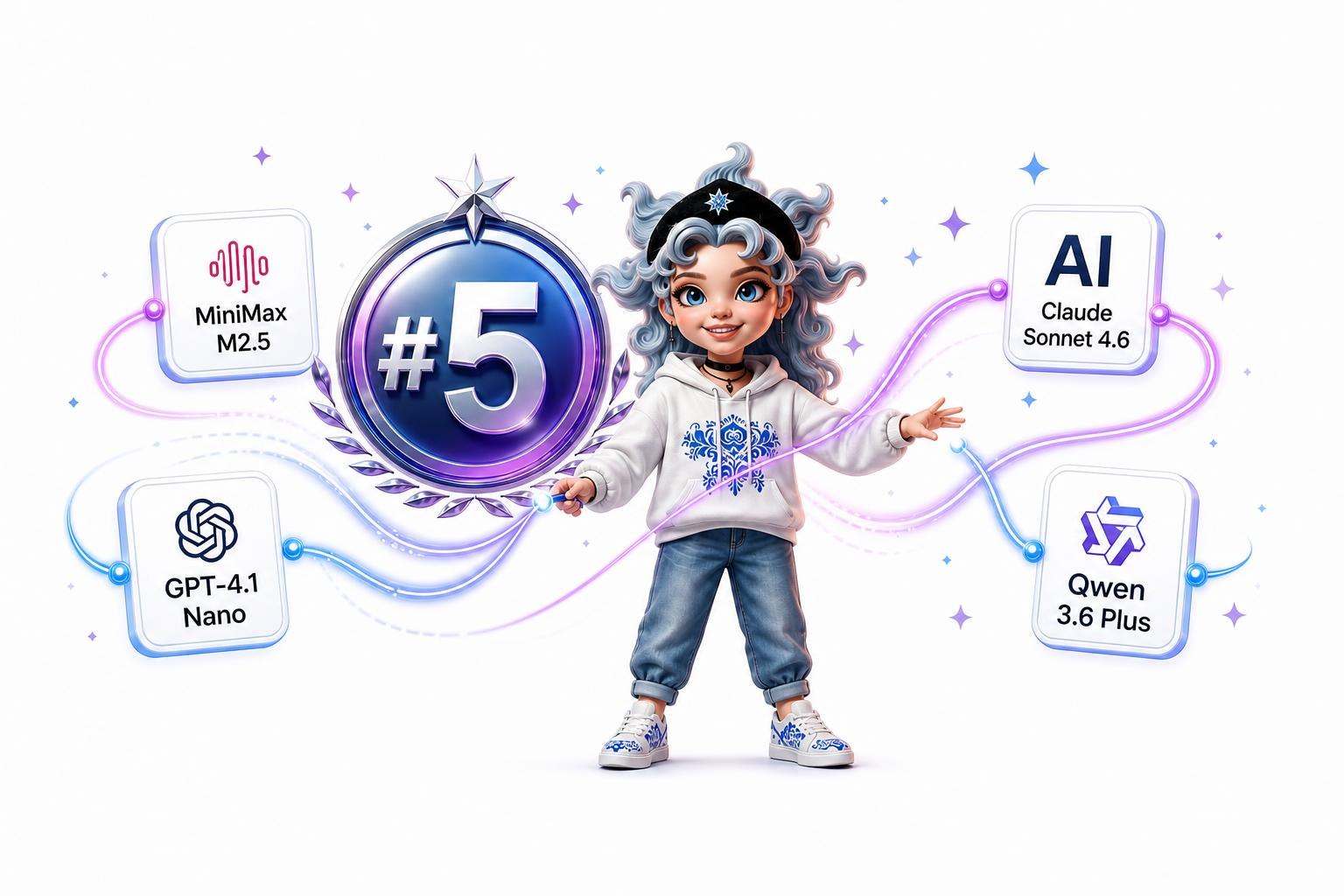
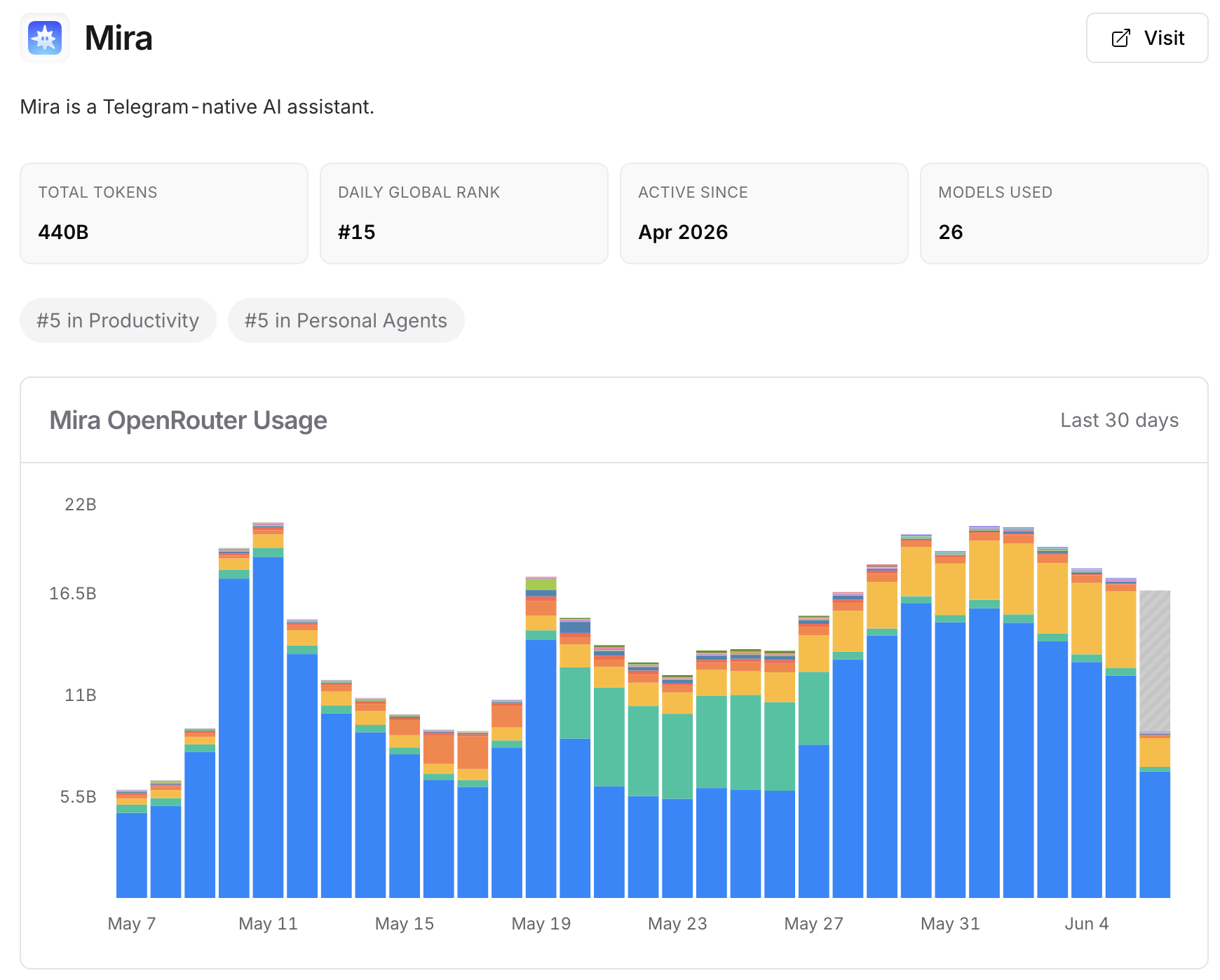
As of May 2026, Mira holds #5 in both Productivity and Personal Agents categories on OpenRouter - with 440 billion tokens processed since launch and a #15 daily global rank across all applications on the platform. She uses 26 different AI models routed dynamically through OpenRouter's infrastructure.
For a Telegram-native AI agent that has been active since April 2026, competing at this scale with dedicated open-source infrastructure projects is a meaningful signal. This article explains what OpenRouter is, why the ranking matters, and what the numbers actually tell you about how Mira works.
What OpenRouter Is and Why Its Data Matters
Independent infrastructure, not self-reported metrics
OpenRouter is an AI infrastructure platform providing unified API access to hundreds of AI models - OpenAI, Anthropic, Google, MiniMax, Z-AI, and dozens of others - through a single endpoint. Applications use OpenRouter as a routing layer that handles model selection, billing, and failover automatically.
OpenRouter tracks every token that flows through its infrastructure. This makes its usage data one of the most accurate independent measures of real AI application activity available anywhere. Rankings on OpenRouter reflect actual requests processed through their servers - not self-reported figures, not registered users, not download counts.
There is no way to game a token count. An application cannot appear in OpenRouter's top rankings without genuinely processing that volume of real requests from real users.
What the Rankings Show
The Productivity category: #5 globally
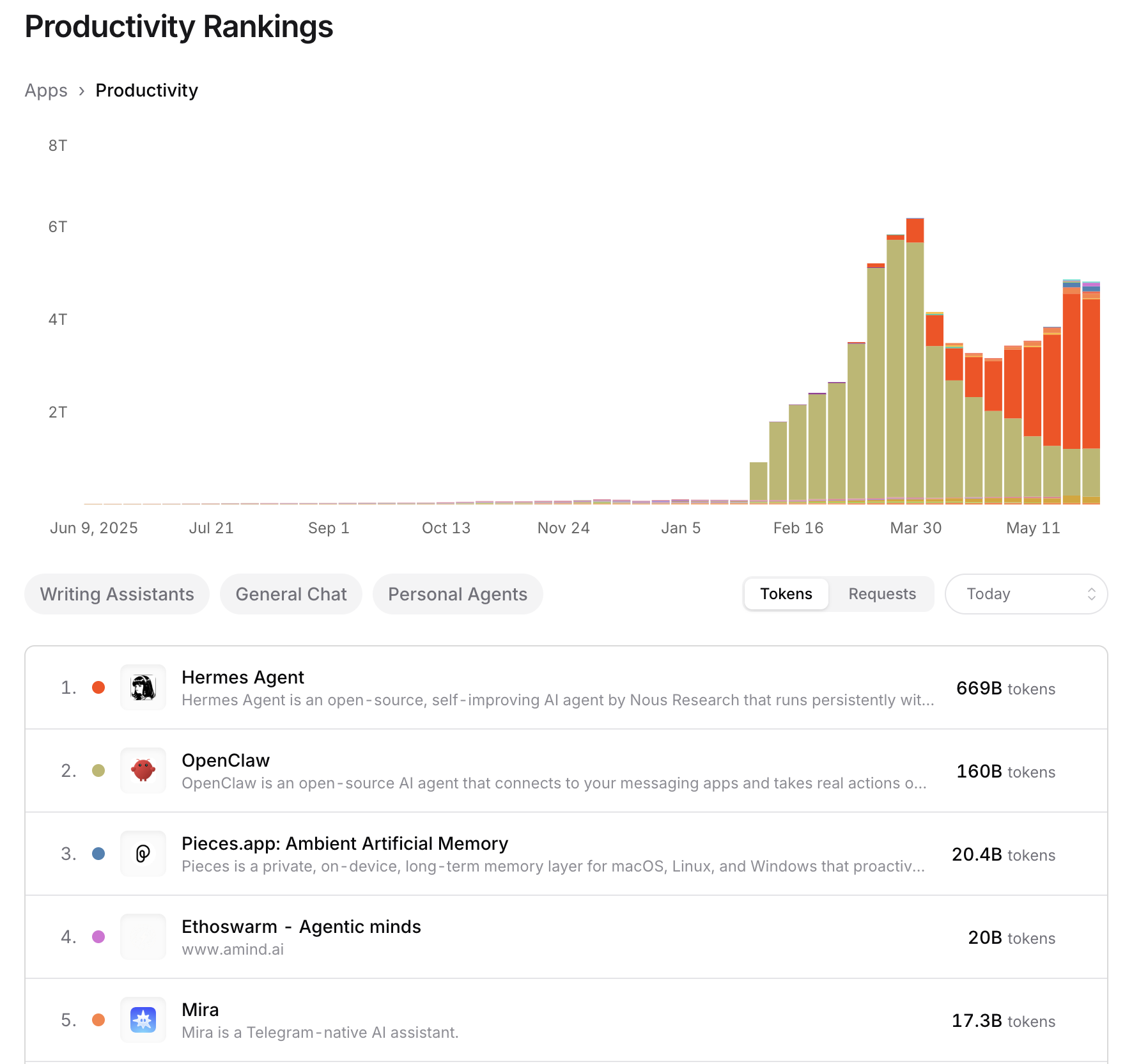
The Productivity Rankings on OpenRouter show the full competitive landscape Mira sits in. The top four as of May 2026:
- #1 Hermes Agent - 669B tokens - open-source, self-improving AI agent by Nous Research
- #2 OpenClaw - 160B tokens - open-source AI agent connecting to messaging apps
- #3 Pieces.app: Ambient Artificial Memory - 20.4B tokens - on-device long-term memory layer for macOS, Linux, Windows
- #4 Ethoswarm - Agentic minds - 20B
- #5 Mira - 17.3B tokens - Telegram-native AI assistant
Why the comparison with #1 and #2 matters
The two applications ranked above Mira with significantly higher token volumes - Hermes Agent and OpenClaw - are both fully open-source developer infrastructure projects. Their token volumes aggregate usage across large developer communities running self-hosted deployments, test environments, and automated pipelines.
Mira's 17.3 billion monthly tokens come from regular people using it inside Telegram to get actual work done - not developers running test environments or CI/CD pipelines.
Ranking #5 as a consumer product competing with developer infrastructure reflects genuine consumer adoption. The comparison also clarifies what the token gap means: Hermes and OpenClaw count every automated test request. Mira counts every real conversation.
Pieces.app at #3 with 20.4B tokens is a closer comparison - it is also a consumer memory product. Mira is within the same order of magnitude, active since April 2026.
What 440 Billion Total Tokens Means
A token is roughly 0.75 words. 440 billion tokens total - with the current monthly run rate of approximately 17 billion - means:
- Roughly 330 billion words of AI-processed content since April 2026
- The equivalent of processing the entire English Wikipedia - approximately 4 billion words - nearly 60 times over
- A monthly run rate of approximately 10 billion words of processed content
That volume reflects the breadth of what Mira handles: conversations, content creation, workflow automation, group chat summarization, research, task management, and the ongoing context that persistent memory requires. It is not a single-use-case number. It is the aggregate of everything a personal AI agent does across an active and growing user base.
How Mira Uses OpenRouter: Multi-Model Routing
26 models, dynamically routed
Mira does not run on a single AI model. She uses OpenRouter to route each request to the best available model for that specific task - automatically, without the user needing to configure anything.
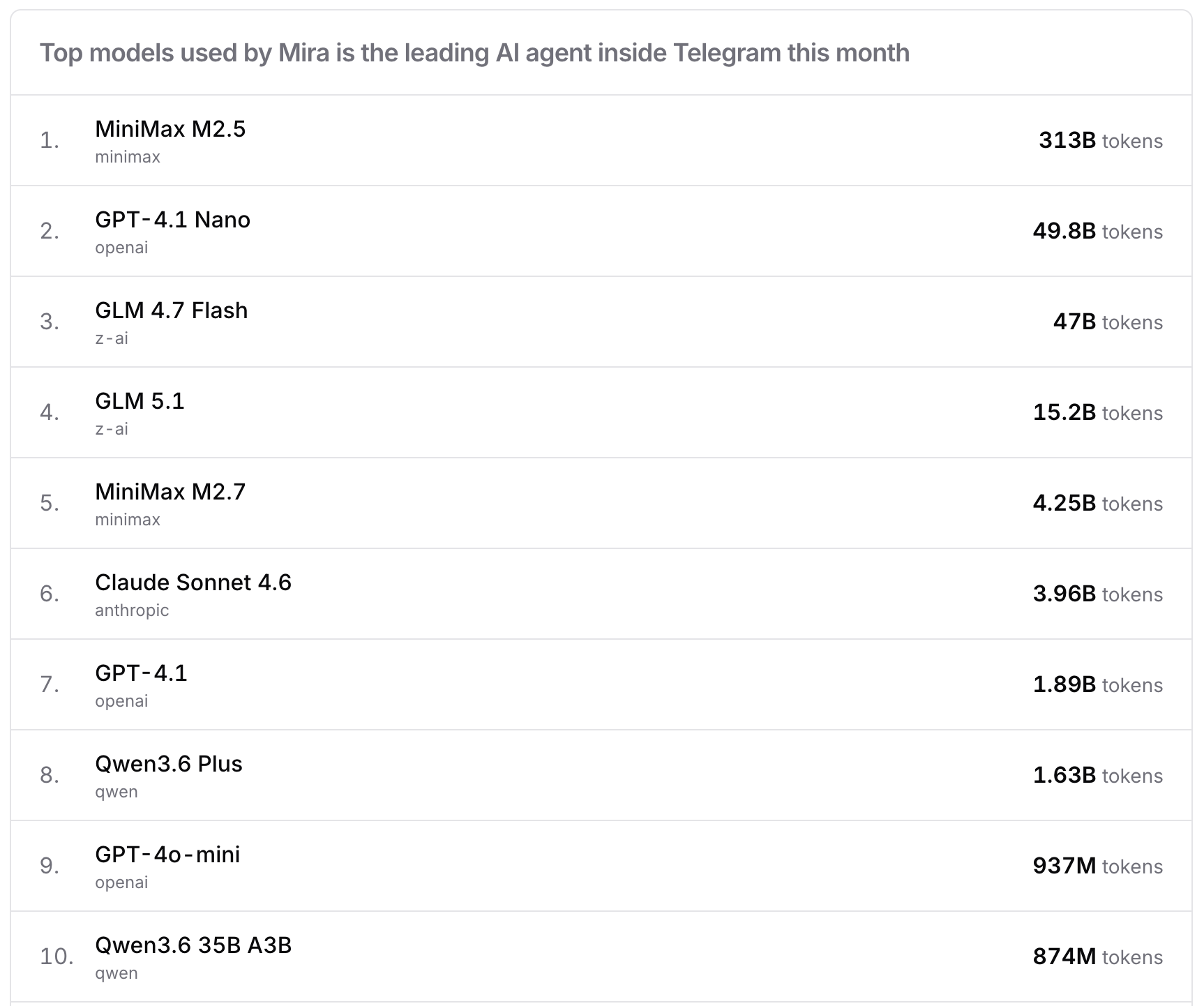
The top models Mira routes through OpenRouter this month:
- MiniMax M2.5 - 313B tokens - primary model for high-volume tasks
- GPT-4.1 Nano - 49.8B tokens - OpenAI's efficient model for lightweight tasks
- GLM 4.7 Flash - 47B tokens - fast responses for conversational interactions
- GLM 5.1 - 15.2B tokens - upgraded conversational model
- MiniMax M2.7 - 4.25B tokens - higher-capability tasks
- Claude Sonnet 4.6 - 3.96B tokens - Anthropic's model for complex reasoning
- GPT-4.1 - 1.89B tokens - premium OpenAI tasks
- Qwen3.6 Plus - 1.63B tokens - additional coverage
- GPT-4o-mini - 937M tokens - OpenAI balanced model
- Qwen3.6 35B A3B - 874M tokens - specialized tasks
Why multi-model routing matters for users
This architecture is one of Mira's core technical differentiators. Rather than being constrained by a single provider's capabilities or pricing, Mira selects the right model for each specific request - optimizing for quality, speed, and cost simultaneously.
The user experiences this as a single coherent assistant. The infrastructure behind it is a dynamic routing layer across the best models available from OpenAI, Anthropic, MiniMax, Z-AI, Qwen, and others. When better models become available on OpenRouter, Mira can route to them immediately - no update required.
The Usage Growth Curve
The Productivity Rankings chart on OpenRouter tells an important story about trajectory. Mira's token volume - visible in the monthly usage chart - shows consistent growth since the April 2026 launch, with peak daily volumes reaching approximately 20 billion tokens on peak days.
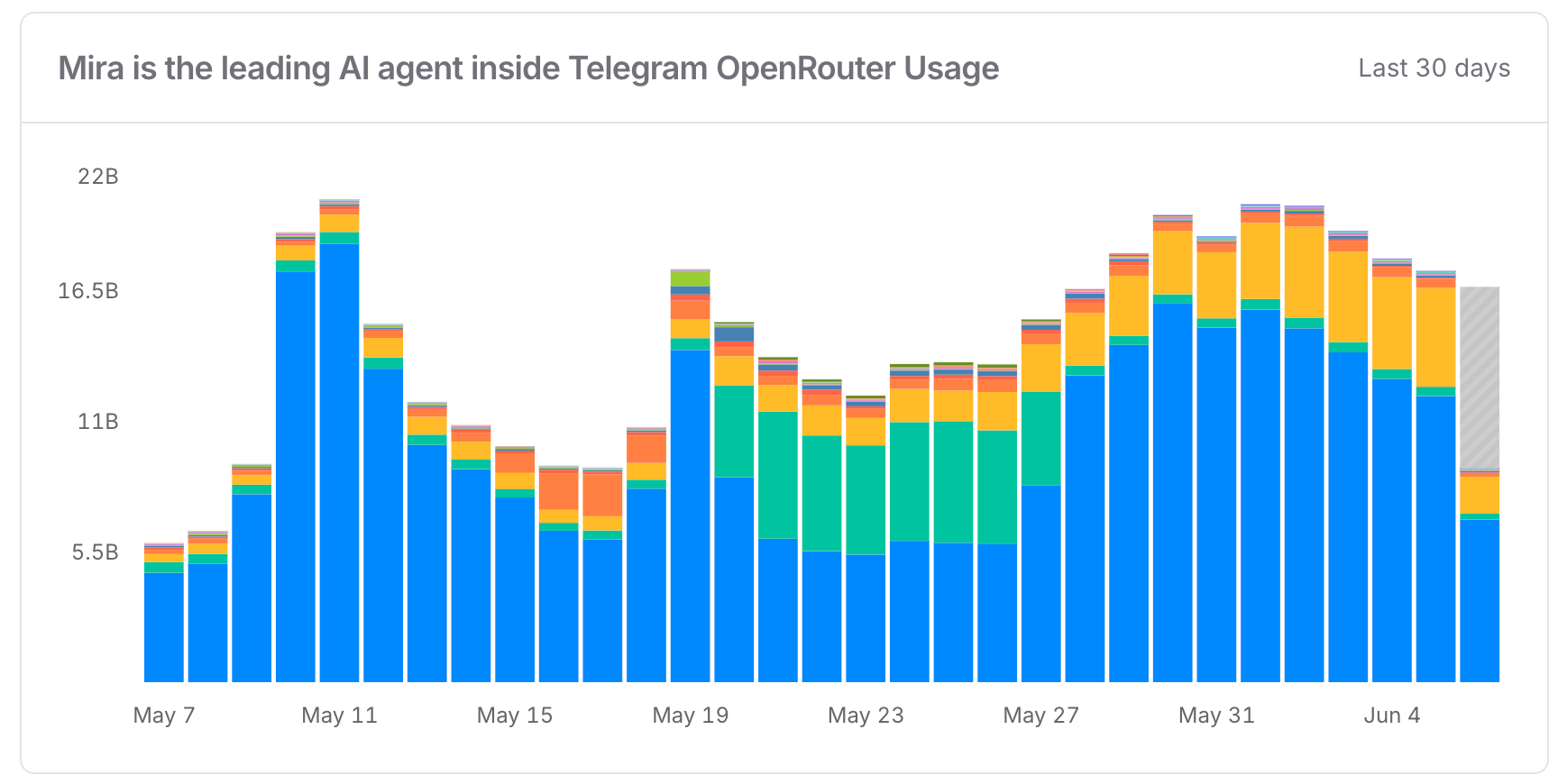
The growth curve reflects product-market fit: users who adopt Mira increase their usage over time rather than churning back to previous tools. That pattern - increasing engagement rather than flat or declining engagement after initial adoption - is the signal that matters most in AI product metrics.
What This Means for Mira Users
The OpenRouter ranking is not just a credibility signal. It has practical implications for anyone using Mira.
Infrastructure at scale. Processing 17 billion tokens monthly requires serious production infrastructure. Mira is not a side project or an early experiment - it is running at the scale of a significant production system, which means the reliability and performance that scale requires.
Model access without lock-in. OpenRouter's infrastructure gives Mira access to every major AI model without being locked into any single provider. The best model for each task gets used for each task - regardless of which company built it.
Independent validation. The ranking comes from OpenRouter's infrastructure data, not from Mira's own reporting. It reflects real usage that cannot be inflated, cherry-picked, or presented misleadingly. #5 in Productivity on OpenRouter - measured the same way for every application in the category.
Active development. The 26 models currently in use reflect ongoing infrastructure work. Mira's routing layer is actively maintained and updated as new models become available - the model mix this month is different from the model mix three months ago, and will be different again three months from now.
A Number Worth Paying Attention To
The AI space is full of metrics designed to impress rather than inform. Token volumes on OpenRouter are different - infrastructure data from an independent platform, reflecting real usage that cannot be manufactured.
440 billion tokens total. #5 in Productivity and Personal Agents globally. Active since April 2026. 26 models routed dynamically. #15 daily global rank across all applications.
For a Telegram-native AI agent less than two months old at the time of measurement, competing in a category alongside open-source infrastructure projects backed by major AI research labs, those numbers tell a clear story: a lot of people are using Mira for a lot of real work - every day, inside the messenger where they already are. It is the same story the user number tell - Mira recently crossed 1 million monthly users inside Telegram.
Those numbers come from real people doing real work. Open @mira in Telegram and add your tokens to the count.