What Is Cocoon AI and How It Works in Telegram

Cocoon AI is a decentralized network built by Telegram that runs AI models on independent GPUs while keeping your requests private from the people operating that hardware. It combines confidential computing with the TON blockchain to offer a more private way to process AI requests.
This guide explains what Cocoon AI is in simple terms, how it works, what benefits it brings, and how you can use it in Telegram.
Who built Cocoon and why
Telegram built Cocoon and launched the network in late 2025. Pavel Durov announced the project on October 29 at Blockchain Life in Dubai, and the network went live on November 30, with Telegram as its first major customer.
Cocoon works as a marketplace between two sides:
- GPU owners provide computing power and earn Toncoin for completed AI requests.
- Developers use that computing power and pay for it in TON.
That is the core of the Cocoon AI TON model: AI workloads run across independent hardware, while the TON blockchain handles payments and maintains a registry of approved machines and models.
The project is designed to address two problems with centralized AI infrastructure: cost and access to user data. Instead of sending every request to infrastructure controlled by a single cloud provider, Cocoon distributes the workload across independent machines while protecting the content being processed.
That said, the network is not fully decentralized today. Cocoon currently controls parts of the routing infrastructure and on-chain registry, with broader community governance planned for later.
How confidential computing works in plain terms
The easiest way to understand Cocoon is to imagine sending a locked box to a computer you don’t own.
The computer can open the box only inside a sealed part of its processor, perform the requested work, put the answer back inside, and return it. The person who owns the computer supplies the hardware and electricity but cannot open the box themselves.
That sealed area is called a Trusted Execution Environment, or TEE. Cocoon currently uses Intel TDX hardware for this purpose.
Before your data is sent, the app checks the machine’s attestation: cryptographic proof from the hardware that it is running the approved software and hasn’t been modified. The request then travels over an encrypted connection that terminates inside the protected environment.
That is what Telegram Cocoon privacy distributed AI means in practice. In the Cocoon decentralized AI network, the GPU operator can process a request without being able to inspect its contents.
There are important limits:
- The GPU operator cannot read your prompt or response.
- The app sending the request can. Its own privacy and retention policies still matter.
- The hardware is part of the trust model. TEEs provide strong isolation, but hardware security is not an absolute guarantee.
So when Cocoon says data isn’t stored by the compute node, it means the node operator cannot retain a readable copy. It does not automatically mean the app you are using keeps no history.
Cocoon compared to regular AI services
The biggest practical difference is not what you can ask the AI. It is who can technically access your request while it is being processed.
| What happens to your request | Standard AI service | Cocoon |
|---|---|---|
| Where it’s processed | Infrastructure operated or contracted by the AI provider | An independent GPU node, inside a TEE |
| Who can technically read it | The provider, subject to its policies and controls | The sending app can; the GPU operator cannot |
| Whether history is kept | Depends on the provider’s retention policy and your settings | The node does not retain readable request data; the sending app sets its own policy |
| Whether it’s used for training | Depends on the provider and your settings | Nodes cannot read the request; the sending app’s policy still applies |
| Who controls the infrastructure | Primarily one provider | Independent GPU owners, although Cocoon still controls some routing and registry infrastructure |
The Cocoon AI network therefore changes the trust model rather than simply offering another chatbot. Regular AI services may provide access to larger proprietary models and more features. Cocoon instead focuses on running open-source models while reducing how much the infrastructure operator can see.
Who Cocoon is actually for
For everyday questions about recipes, travel plans, translations, or the weather, you may never notice whether an AI request runs through Cocoon or a regular provider.
Private processing becomes more useful when the prompt contains information you would not want the infrastructure provider to see.
Typical use cases for Telegram Cocoon decentralized AI include:
- Legal work: Reviewing contracts, case details, or client information where confidentiality matters.
- Finance: Working with unreleased financial results, deal terms, investment information, or internal forecasts.
- Healthcare: Processing sensitive clinical information, although using Cocoon alone does not make an application compliant with healthcare regulations.
- Confidential business work: Discussing unreleased products, roadmaps, pricing, launch plans, or other internal information.
The common factor is not that these tasks require a different kind of AI. They contain data that carries a higher cost if exposed.
For low-sensitivity everyday prompts, a conventional AI service may be just as practical. Cocoon becomes relevant when who can access the request during processing actually matters.
How to use Cocoon from Telegram with Mira
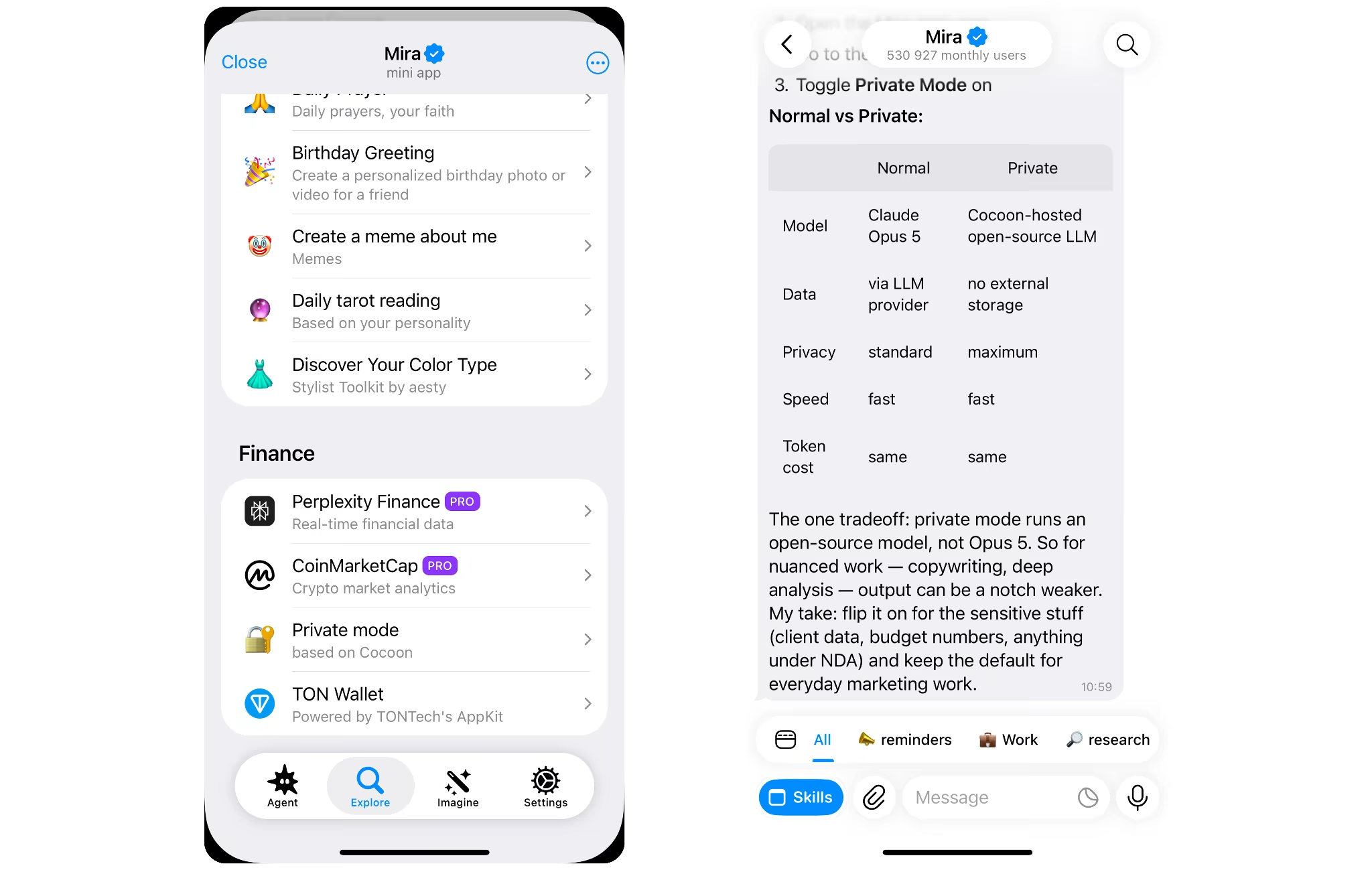
Cocoon itself is infrastructure, not a chatbot you open and start messaging. One way to use Cocoon AI in Telegram directly is through Private Mode in @Mira.
Mira is a Telegram-native AI agent. To use Cocoon, open Mira’s mini app, go to Explore, and turn on Private Mode. You can then continue chatting in the same conversation. There is no separate Cocoon app to install.
What changes is how the request is processed. Private Mode sends requests through Cocoon instead of a standard model provider and currently runs Qwen3-32B, an open-source model.
Normal Mode uses a different model setup and may be better suited to more demanding reasoning or writing tasks.
Privacy also comes with some practical limits. Mira says Private Mode requests are not stored, while Cocoon prevents the GPU operator from reading them. However, your messages still pass through Telegram as cloud chats, so Telegram Cocoon AI protects the AI-processing layer, not Telegram itself.
Tasks that require connected apps also fall outside that boundary. If the Mira AI agent needs to access Gmail or another external service, that data has to be sent to that service. For those workflows, use Normal Mode.
What is Cocoon AI summary
In short, Cocoon AI is Telegram’s decentralized network for running AI models while keeping requests private from the GPU operators processing them. It combines confidential computing with TON to give apps a more private way to use AI without relying on a single centralized provider.
For users, the Cocoon AI summary is simple: you get AI features with an additional layer of privacy built into how requests are processed.