AI Fact Checker: Verify AI-Generated Claims Against Primary Sources
An AI fact checker speeds up the slow parts of verification: pulling claims out of a text, lining them up against sources and spotting what doesn't match. It doesn't supply the proof. Every verdict still has to rest on a source you can open and read yourself.
That gap matters because AI writes confident text whether or not it's right. A made-up citation looks exactly like a real one. A two-year-old number reads the same as this month's. A summary that drops one qualifier can flip what the original said.
Below is a six-step method for AI fact-checking, reusable prompt templates, and a checklist for the end.
What an AI fact checker does (and what it can't)
An AI fact checker uses a language model to pull factual claims out of text, match each one with evidence and flag gaps or contradictions. That's what AI fact-checking comes down to: it sorts and compares. The decision about what's true stays with you and the source.
| AI is good at | AI is weak at |
|---|---|
| Listing every checkable claim in a long draft | Knowing about events after its training data ends |
| Summarizing a long report so you know where to look | Confirming a source exists when it can't open it |
| Spotting contradictions inside one text | Judging whether an author is a real expert |
| Comparing a claim with a passage you paste in | Telling a confident error from a fact |
| Turning rough notes into a clean evidence table | Taking responsibility for the verdict |
The reason for the right-hand column is simple. Language models predict likely text. They don't look facts up unless they're connected to a source, so a reference can have a believable author, journal and year and still not exist.
Use AI to identify what needs checking. Use sources to verify it.
Why fact-checking AI output matters now
Fact-checking AI output matters because the errors are quiet. Nothing in the text signals which sentence is wrong, and three failures show up more than any others:
- Invented references: One widely cited study found that 55% of citations from GPT-3.5 and 18% from GPT-4 were fabricated. Citation hallucinations remain a risk even with newer AI models.
- Stale numbers: Prices, rankings, laws and product features change after a model's training data ends, and the model keeps quoting the old figure.
- Meaning drift: "May reduce risk in some patients" becomes "reduces risk." Same topic, different claim.
The stakes depend on the claim. A wrong date in a blog post costs credibility. A wrong dose, deadline or tax figure can cost someone their health or their money.
How to fact-check AI-generated content in 6 steps
To fact-check AI-generated content, break it into separate claims, trace each one to its original source, confirm the source says the same thing, back it with an independent second source, check the date and write a verdict that matches the evidence.
Use the prompt templates below to speed up the verification process in any AI assistant.
Step 1. Break the text into checkable claims
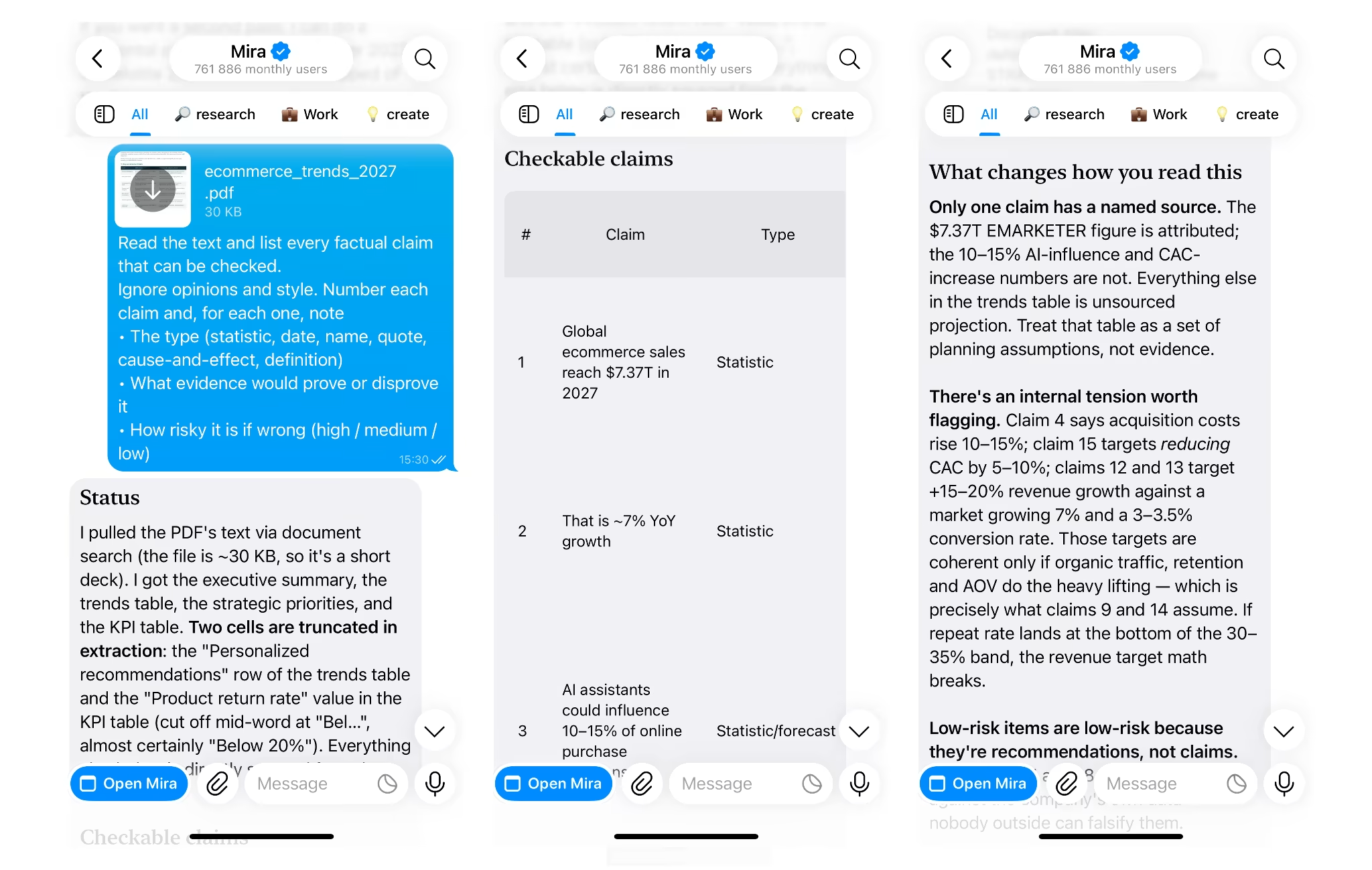
Start by listing every statement that could be proven true or false: names, dates, numbers, quotes, definitions and cause-and-effect claims. Skip opinions and framing. Number each claim so you can associate it with its source and verdict.
Then sort by risk. A claim a reader will act on comes first. A background detail can wait.
🟢 Prompt to try:
This is where AI saves the most time. A 2,000-word draft can hold 30 or 40 checkable claims, and a model lists them in seconds.
Step 2. Trace each claim to its original source
The original source is the document where the fact first appeared: the dataset, report, court filing, company announcement or research paper. An article quoting that document isn't the source. A third article quoting the second is even further away.
For each source, note three things: who published it, when it was published and what period the data covers. Those dates often differ by a year or more.
🟢 Prompt to try:
With the Mira AI agent, you can forward the draft or the message with the claim straight into the chat, run this prompt and ask Mira to save the claim list to a Google Doc or Notion page. The whole team then works from one list instead of five copies.
Step 3. Check that the source actually says what the claim says
Open the source and read the passage the claim depends on. This is the step people skip, and it's where most errors live.
The gaps are usually small:
- Rounded up: 38% becomes "nearly half."
- Certainty added: "May" becomes "does."
- Scope widened: Results for one group are presented as results for everyone.
- Cause invented: Two things that happen together become one causing the other.
🟢 Prompt to try:
A real source that doesn't support the claim is still a failed check.
Step 4. Confirm with an independent second source
A second source counts only if it has a different origin. Two news stories rewriting the same press release are one source, not two. Fact-checking organizations such as Full Fact aim for at least two sources on a check's central claim, unless only one relevant source exists.
This habit is called lateral reading: you leave the text and see what other sources say about the claim and its publisher. The SIFT method (Stop, Investigate the source, Find better coverage, Trace claims to the original) is a compact version of the same idea.
For example, Mira routes across 10+ AI models, so you can ask a second model to run the same check. That helps catch obvious slips. It isn't a second source, though, because both models learned from similar data.
Step 5. Check the date and context
A claim can be accurate and still outdated. Check whether the source has a newer edition, a revised dataset or a later correction. Fast-moving topics need this every time: prices, rankings, regulations, job titles and product features.
Context counts too. A statistic from one country, one year or one survey sample doesn't automatically describe everyone else. If a statistic lacks a relevant date or denominator, treat it as unverified until you find the missing context.
For pages you keep updating, Mira runs scheduled tasks. A monthly reminder to recheck the fast-moving figures takes one message to set up.
Step 6. Write a verdict that matches the evidence
Use a small, fixed scale so verdicts stay comparable from one check to the next:
- Supported: The primary source and an independent source both confirm the claim as worded.
- Partly supported: The main claim is accurate, but a number, the scope or the level of certainty is off.
- Unsupported: The source contradicts the claim or says something different.
- Unverifiable: No source turned up. That isn't the same as false.
- Outdated: The claim was true at an earlier date and has since changed.
Then rewrite each claim so it says no more than the evidence allows. That rewrite is usually the most useful output of the whole check.
🟢 Prompt to try:
How to verify AI-generated citations
To verify AI-generated citations, confirm three things: the paper exists, its details match, and it says what the text claims it says. A citation can pass the first two checks and still fail the third.
Hallucinated citations usually take one of five forms:
| Type | What it looks like |
|---|---|
| Fully fabricated | A plausible title, authors and journal for a paper that doesn't exist |
| Real authors, invented paper | Names of real researchers attached to a title they never wrote |
| Merged reference | Details from two real papers combined into one that doesn't exist |
| Metadata mismatch | A real paper with the wrong year, journal, volume or DOI |
| Misattributed claim | A real paper that doesn't contain the claim it's cited for |
Checking a reference takes a few minutes:
- Find the title: Look it up in Google Scholar or on the publisher's site.
- Resolve the DOI: A DOI (Digital Object Identifier) is a unique, persistent identifier for a publication, such as a research paper or dataset. Paste it into doi.org and confirm it opens the same paper, not a different one.
- Match the metadata: Compare the authors, year and journal with the publisher's record or Crossref.
- Read the cited passage: Find the part of the paper that supports the claim.
- Check for retractions: A retracted paper should not be used as reliable evidence.
🟢 Prompt to try:
The AI's job here is to hand you a clean list to check. Confirmation comes from the publisher's record.
How to check an AI summary against the original
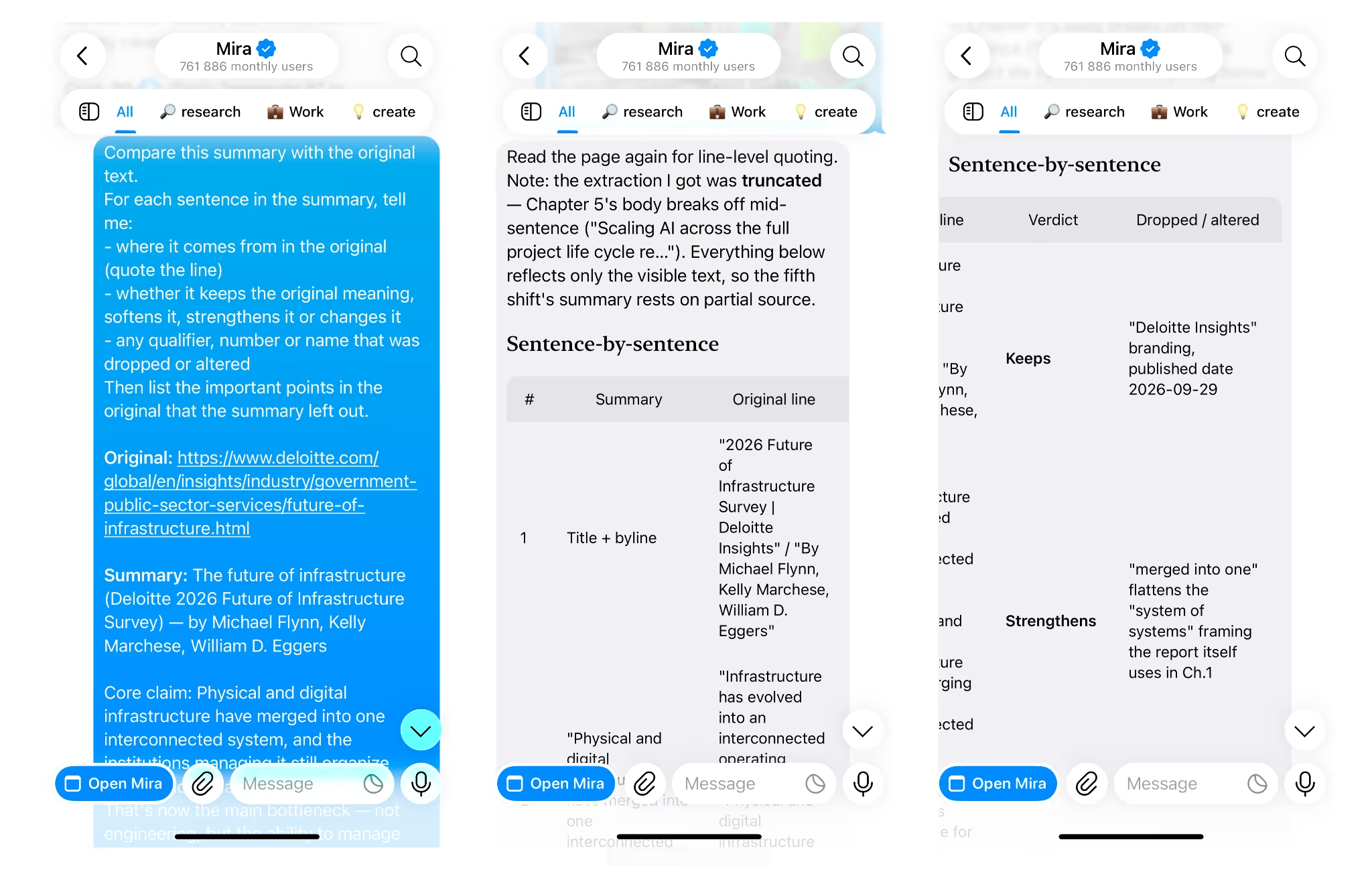
Check an AI summary by taking the three to five points you'll act on and finding each one in the original text. Compare the wording, the numbers and who said it. If a point isn't in the original, it doesn't go into your decision.
Summaries fail in predictable ways:
- Dropped qualifiers: "In some cases" and "early results suggest" disappear.
- Merged numbers: Two figures from different sections turn into one.
- Wrong attribution: A point an analyst made becomes something the CEO said.
- Implied cause: Two events listed in order become one causing the other.
This is one of the most common fact-checking tasks when working with AI-generated content because most people encounter AI output as a summary of a report, a thread or a meeting.
Mira summarizes long group threads and forwarded messages inside the messenger. A good habit is to ask for the summary together with the original lines each point came from, then spot-check the lines that matter before you act.
🟢 Prompt to try:
A summary is a pointer to the original, not a replacement for it.
AI fact-checking tools vs. AI-assisted fact-checking
There are two ways to bring AI into verification: a dedicated tool that returns verdicts, or a general AI assistant that runs your own process. Dedicated tools are faster for a one-off check of a public claim. An assistant fits better when checking is part of daily work and the material lives in chats, docs and inboxes.
| Dedicated tool | AI-assisted fact checking | |
|---|---|---|
| How it works | Paste text or a URL, get verdicts with links | You run the steps with your own prompts |
| Speed for one claim | Fast | Slower the first time |
| Control over method | Set by the tool | Yours: sources, verdict scale, format |
| Fit with daily work | A separate site or plugin | Works where the material already is |
| Best for | Public claims, quick checks | Drafts, reports, team threads, recurring checks |
The trade-off is convenience versus control. A tool gives you a verdict fast but decides how it gets there. An assistant takes a few prompts to set up, then follows your rules every time.
Mira is built for the second approach. It works inside the messenger, so you can forward a message, a voice note or a link, or tag @mira in the group chat where the claim came up, and run the checks right there.
The AI agent remembers your rules across conversations, so you set the verdict scale and preferred sources once. With your permission, it saves the evidence table to Google Docs or Notion, and it connects to 1,000+ tools for the rest of the workflow. Anything that writes to a connected app asks for your approval first.
Setting the rules takes one message.
🟢 Prompt to set the rules:
Which claims need an expert or a primary record
Some claims can't be verified by AI or secondary sources alone. They need a qualified expert or the primary record itself:
- Health: Diagnoses, doses, drug interactions and treatment claims.
- Legal: Rights, deadlines, eligibility and what a law or contract actually says.
- Financial: Tax figures, rates, fees and anything that drives a money decision.
- Safety: Instructions where a mistake could injure someone.
- Quotes: Anything attributed to a real person, checked against the recording or full transcript.
A primary record is the original document: an official register, a court filing, a company filing, a product label or a full transcript. If the claim depends on one, read the record, not a summary of it.
AI fact-checking checklist
Run through this list before anything AI-assisted goes live:
- Claims extracted, numbered and sorted by risk
- Original source opened for every high-risk claim
- Source passage supports the claim as worded
- Independent second source with a different origin checked, where available
- Publication date and data period checked, including any recent updates or corrections
- Every statistic has the necessary context, including a denominator and time frame where applicable
- Every citation verified: title, authors, year and DOI where available
- Sources checked for retractions
- Verdict matches the evidence, and wording adjusted to fit
- Expert consulted or primary record verified for health, legal, financial and safety claims
- Direct quotes verified against the original recording or full transcript
Fact-check where the claims show up
AI fact checking makes verification faster. Sources make it reliable. The method above works in any assistant, but it works best where claims actually arrive: in the chats, threads and forwarded messages you already deal with every day.
Mira lives in your messenger, remembers your fact-checking rules and saves evidence tables to your docs on request. The check happens before the claim moves on.