What Is Decentralized AI, and Why the Movement Is Growing Fast
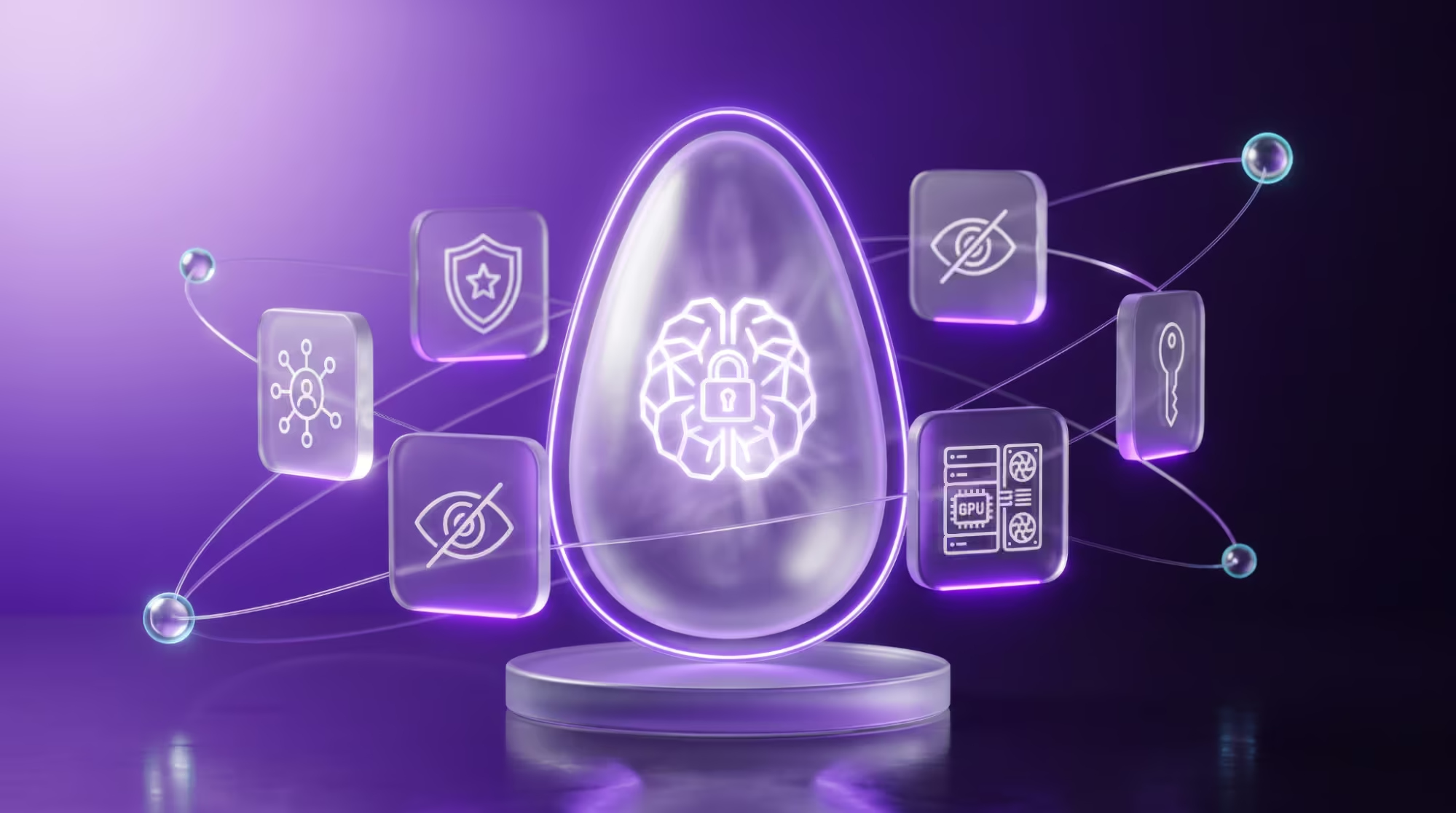
Decentralized AI is artificial intelligence that distributes computing, data, or model access across independent devices and networks instead of relying on a single company's infrastructure.
The idea is gaining momentum quickly. The global decentralized AI market was valued at $3.5 billion in 2025 and is projected to reach $9.2 billion by 2034, according to Intel Market Research. The related decentralized compute market is also projected to grow from $7.12 billion in 2025 to $22.48 billion by 2030.
The appeal is straightforward: decentralized AI promises more control over data and computing resources, less dependence on a handful of large providers, and new ways to build and run AI systems. This guide explains how it works, how it differs from centralized AI, and where the movement is heading.
What is decentralized AI?
Decentralized AI is AI without a single owner in the middle. Instead of your request traveling to one company's servers, getting processed there, and coming back, the work is spread across a network of independent machines or run locally on your device. No central operator sees everything, sets every rule, or holds every conversation.
The decentralized AI meaning comes down to where the compute happens and who controls it:
- In a centralized system, one provider owns the model, the servers, and your data trail;
- In a decentralized one, those are split apart: the model can be open, the compute can come from many providers, and the data can stay with you.
That shift enables a different class of decentralized AI applications. Think a private assistant that processes sensitive questions inside a sealed environment, a translation model that runs offline on your phone, or a network where anyone with a spare GPU can run jobs for pay. The common thread is that no single party is a chokepoint for access, pricing, or surveillance.
You still get a capable model. You just stop routing your entire digital life through one company to use it.
Centralized vs decentralized AI, what actually changes
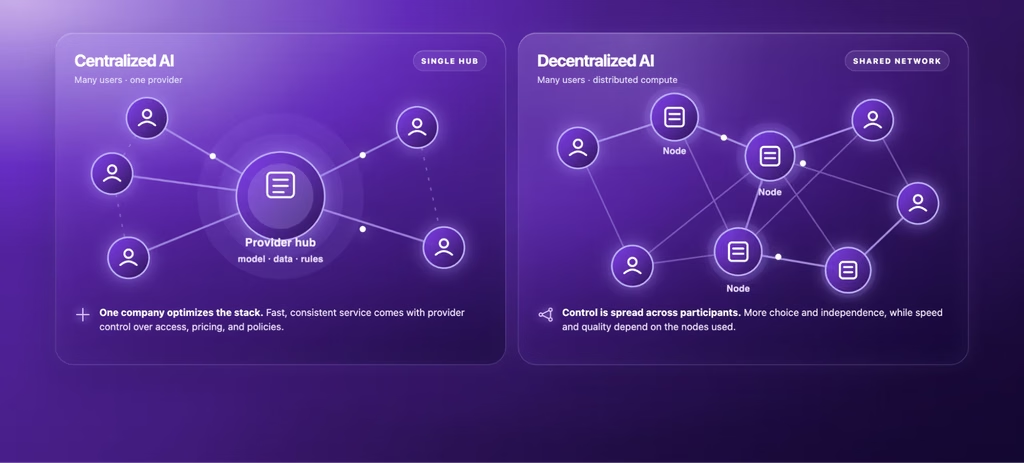
The difference is control: who holds your data, who owns the model, and who can change the rules.
Centralized AI is fast and polished because one company optimizes the whole stack. Decentralized AI trades some of that consistency for privacy, ownership, and independence from any single provider.
| Feature | Centralized AI | Decentralized AI |
|---|---|---|
| Where your data lives | On the provider's servers (OpenAI, Google, Anthropic) | On distributed nodes or your own device |
| Who controls the model | One company sets the limits, price, and policies | Shared across a network; no single owner |
| Privacy | Prompts can be logged, reviewed, or used to train | Processed in isolation; often not retained or trained on |
| Cost structure | Subscription or per-token, set by the provider | Market-priced compute; providers compete for jobs |
| Speed and performance | Fast, consistent, heavily optimized | Varies by node; improving but uneven |
| Examples | ChatGPT, Gemini, Claude | Cocoon, federated learning, on-device assistants |
On raw decentralized AI vs. centralized AI performance, centralized still wins on speed and consistency today. A single optimized data center beats a distributed network on latency. The gap narrows every year, but if you only care about the fastest possible answer, centralized is ahead. The trade you make for decentralization is privacy and control, not speed.
One familiar example of the local-first idea is the AI voice assistant that runs on your device instead of streaming every word to the cloud.
Why decentralized AI matters for privacy
Decentralized AI matters for privacy because your data never has to leave your control to get useful answers.
In a centralized setup, every prompt lands on someone else's servers, where it can be logged, reviewed by staff, or fed back into training. Privacy first AI removes that default exposure: the model comes to your data, or your data is processed where no operator can read it.
Two mechanisms make this work:
- The first is confidential AI computing inside a Trusted Execution Environment (TEE), a hardware-sealed enclave where a request is decrypted, processed, and returned without the machine's owner ever seeing the contents.
- The second is local-first AI for data privacy, where a smaller model runs on your own device and nothing goes to a network at all.
Blockchains add a settlement and trust layer on top. How does blockchain support data privacy here? Not by storing your data on-chain, which would be the opposite of private, but by handling payments, verifying that a node ran the job correctly, and proving the enclave was genuine, all without exposing the underlying conversation. The key words to know are data sovereignty (your data stays yours) and zero-knowledge (proving something is true without revealing the data behind it).
The result is a secure AI assistant you can use for sensitive work without assuming every word is being kept.
Main benefits of decentralized AI
The biggest benefits come down to privacy, ownership, and independence from any single company. Here are the ones that matter in practice.
- Privacy by default: Your prompts are processed in isolation or on your device, not logged on a corporate server. For health questions, legal drafts, or business plans, that means you can use a capable model without treating every message as permanently recorded.
- Data ownership: You keep custody of your own information (data sovereignty), instead of trading it for access. The model works for you without the provider building a profile from everything you ask it.
- Censorship resistance: No single company can cut off access, block a topic, or change the terms overnight. Decentralized AI agents run across many independent nodes, so there's no one switch to flip.
- Less big-tech dependence: Compute comes from a competitive market rather than three cloud giants. That lowers the risk of price hikes, sudden policy changes, or a single outage taking your tools down.
- Transparency and governance: Open models and open networks can be inspected, audited, and steered by their communities. Decentralized AI governance spreads decisions across participants instead of concentrating them in one boardroom.
- Fairer cost over time: In a compute marketplace, providers compete on price for each job, which pushes the cost of inference down as the network grows.
Risks and challenges of decentralized AI
Decentralized AI is not automatically better, and the honest risks of decentralized AI technology are worth naming before you switch. The upside is real, but so are the current limits.
- Speed and reliability: Distributed networks are slower and less consistent than a single tuned data center. Latency varies by node, and uptime depends on the network staying healthy.
- Model quality: The strongest frontier models are still mostly closed and centralized. Open models that can run in decentralized settings are catching up, but the very top of the benchmark tables is not there yet.
- User complexity: Wallets, nodes, and enclaves add friction. Without a product that hides this, decentralized AI development still asks more of the user than opening a chatbot.
- Regulatory uncertainty: Rules for cross-border confidential compute, model export, and encrypted processing are unsettled. That ambiguity is a genuine risk for builders and users alike.
The takeaway: pick decentralized AI where privacy and control are the priority, not where you need the fastest or most powerful model available.
Decentralized AI platforms and approaches in 2026
There is no single decentralized AI platform; there are several distinct approaches, each with its own trade-offs. The clearest way to see the 2026 landscape is to compare how they actually work.
| Approach | How it works | Example | Best for |
|---|---|---|---|
| Federated learning | The model trains across many devices; only updates are shared, never raw data | Phone keyboard prediction | Improving models without pooling personal data |
| On-device AI | The model runs locally; nothing leaves your hardware | Local LLMs, on-device assistants | Maximum privacy and offline use |
| TEE-based confidential compute | Requests run inside a hardware-sealed enclave the operator can't read | Telegram Cocoon (Intel TDX) | Private, cloud-grade inference at scale |
| Blockchain-based compute markets | GPU owners run jobs and settle payment on-chain | Cocoon on TON, other DePIN networks | Censorship-resistant, pay-per-use compute |
| Open-source distributed models | Openly published weights anyone can host and run | Llama, Qwen, DeepSeek self-hosted | Transparency and no vendor lock-in |
A blockchain-based compute market is essentially a decentralized AI marketplace: it wires together the decentralized AI infrastructure (the GPUs and enclaves) and the decentralized AI network (the settlement and coordination layer) so demand and supply can meet without a central broker.
That combination is the clearest of the decentralized AI trends 2026, because it's the first version normal users can reach without running anything themselves.
How Mira and Cocoon bring decentralized AI to your messenger
Mira is an AI agent that brings decentralized AI to the messenger you already use, with no new app and no setup. It’s a private Telegram-native agent: you message @mira like any other contact, and it handles tasks, answers questions, and connects to your tools.
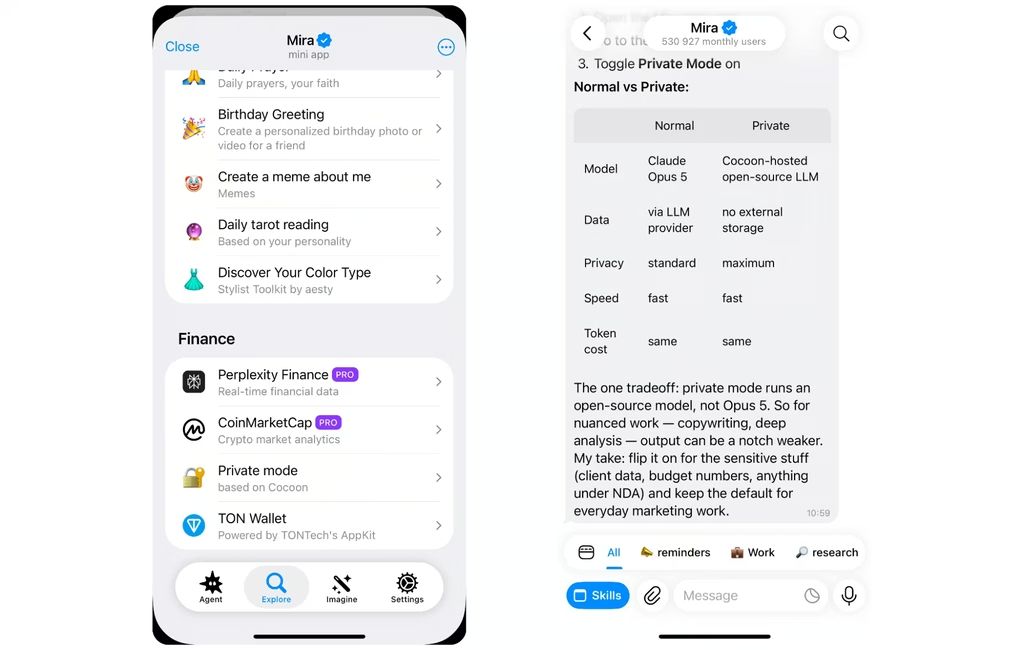
Turn on Private Mode and your request stops going to a standard cloud model. It routes instead to Cocoon, Telegram's confidential-compute network, where the model runs inside a hardware-sealed enclave (a TEE). The node operator supplying the GPU can't read your prompt or the reply.
That is the Telegram Cocoon decentralized AI stack in practice: the privacy of a decentralized AI assistant, delivered through a chat you already trust. For sensitive threads, health questions, legal drafts, or anything you'd rather not have logged, you get privacy-first conversational AI without switching to a niche tool or self-hosting a model. It's a privacy-first AI assistant that fits into a conversation instead of a dashboard.
The rest of the time, Mira works as a full Mira AI agent: model-agnostic, routing across 10+ models and picking the best one per task, with access to 1,000+ connected tools. You choose privacy when you want it and speed when you don't, from the same Mira chat. That's the practical version of the whole movement: a Mira agent that puts the choice in your hands.