

AI for healthcare refers to software that uses artificial intelligence to support clinical care, patient communication, documentation, and hospital operations. By January 2025, the FDA had authorized more than 1,000 AI-enabled medical tools, showing how quickly the category has expanded.
AI for healthcare isn't one product category anymore. It's split into multiple distinct jobs: reading scans, writing chart notes, talking to patients, and running hospital operations, and the tool that's best at one is usually mediocre at the others. AI for doctors, AI for healthcare providers, and AI for hospital operations are three different shopping lists, even though they all get bundled under one search term.
This guide breaks down what AI is actually used for in healthcare right now, compares the tools worth knowing about in each category, and covers where a personal AI like the Mira AI agent fits and where it doesn't.
What Is AI for Healthcare Used For?
AI for healthcare falls into five practical buckets, and knowing which one you need narrows the tool search fast.
- Diagnosis and clinical decision support: Reading images, flagging abnormal results, and surfacing treatment options based on a patient's data.
- Documentation and scribing: Turning a patient conversation into a structured chart note, automatically. This is also where AI medical transcription and AI charting for doctors live.
- Conversational and voice AI: Handling patient-facing calls, scheduling, and triage questions, usually through an AI chatbot for healthcare or a voice agent.
- Hospital and practice operations: Capacity planning, prior authorization automation, coding, and healthcare revenue cycle AI.
- Personal productivity: The non-clinical admin like email, scheduling, research, reminders that eats into a healthcare professional's day but never touches a patient chart.
Most AI solutions for healthcare sit in exactly one of these buckets. That's why the best AI for healthcare has no single answer — the honest answer is best for which bucket.
How AI for Healthcare Plays Out in Practice
Each category above solves a different bottleneck, and seeing them as scenarios makes the difference clearer than a feature list does.
- Catching a time-sensitive finding: An ED orders a CT scan for suspected stroke, and diagnostic AI flags a large-vessel occlusion and pages the stroke team before the radiologist has formally signed off, shaving minutes off a window where minutes matter.
- Finishing notes before leaving the building: A physician sees 20 patients in a day, and an AI scribe drafts each chart note from the room conversation, cutting a task that used to spill into the evening down to a quick review and sign-off.
- Triaging after-hours calls: A patient calls a clinic at 9 p.m. with a non-urgent question, and conversational AI handles the intake, checks it against triage rules, and either books a next-day slot or escalates to an on-call nurse without a staff member picking up the phone. This is what AI for patient triage looks like in a live clinic.
- Filling a canceled slot: A patient cancels at 7 a.m., and an AI scheduling tool for healthcare pulls the right person off the waitlist and confirms by text before the front desk has opened.
- Forecasting bed capacity: An operations team runs AI for healthcare data analysis on historical admission patterns to predict tomorrow's patient volume and staff accordingly, instead of reacting to a full waiting room in real time.
- Clearing the inbox before rounds: A physician asks the Mira AI assistant to summarize an overnight group chat with colleagues and draft replies to non-clinical emails, so the first 15 minutes of the day go to patients instead of triage-by-scrolling.
Best AI Tools for Healthcare in 2026: Quick Comparison
AI for Healthcare Diagnosis and Clinical Decision Support
These tools read medical data and flag what a clinician should look at next. They don't replace the read, they speed it up.
- Viz.ai analyzes imaging for time-sensitive conditions like stroke and alerts the care team before symptoms fully develop.
- PathAI applies AI to digital pathology slides and holds FDA clearance for primary diagnosis use.
- Tempus combines genomic profiling with clinical data for precision oncology, and is used by roughly two-thirds of US academic medical centers.
All three require clinical validation and direct EHR or lab integration; they're built for hospitals and health systems, not individual practitioners working solo.
AI for healthcare diagnosis is the most tightly regulated corner of this market, and AI for medical doctors in radiology, pathology, and oncology is where FDA clearance actually matters.
AI Scribes for Doctors: Documentation, Transcription, and Charting Tools
An AI scribe listens to a patient visit and drafts the chart note, cutting documentation time by roughly half in most reported cases.
Ambient AI for doctors is the same product under a different label: the microphone stays on for the whole visit and nobody presses record. You'll also see this category sold as an AI medical scribe, an AI documentation assistant for doctors, or simply AI for doctors notes. The underlying job is identical.
- Nuance DAX (Microsoft) is the deepest-integrated option for Epic-based health systems.
- Abridge does the same ambient note-taking and is expanding into medical coding and billing.
- Suki AI adds voice-driven EHR navigation on top of note generation.
- For smaller practices, Freed and Heidi Health are the budget picks. Heidi has a free tier, and both claim under an hour to set up with no IT team.
Important note: AI medical transcription is not the same product, and the difference costs money.
AI medical transcription software turns speech into verbatim text and stops there, which is what AI dictation for doctors has done for two decades.
An AI scribe goes further: it structures the conversation into a SOAP note and files it into the chart. If you want AI charting for doctors, you need a scribe. If you only need a clean transcript, AI tools for medical transcription are cheaper, and Dragon Medical One is still the default choice for AI for medical transcription.
If you're searching for a free AI scribe for doctors, start with Heidi's free tier rather than a trial of an enterprise tool. Enterprise scribes are priced and built for hospital procurement, not solo practice budgets.
Free AI for doctors exists at the low end, but expect a cap on visits per month, and expect the best AI scribe for doctors to depend more on which EHR you run than on which model sits behind it.
Conversational and Voice AI for Healthcare
Conversational AI for healthcare mostly means one thing in practice: answering the phone and the front desk so staff don't have to.
Talkie.ai handles inbound calls, appointment scheduling, prescription refill requests, and waitlist management, with EHR integrations into systems like athenahealth and Elation Health.
An AI voice agent for healthcare handles the call itself. An AI chatbot for healthcare handles the same requests over text, on your website or inside a patient portal. AI voice agents for healthcare are judged on call-handling accuracy and how well they integrate with the scheduling system already in place, not on general conversational ability.
AI for Hospital Operations and Healthcare Administration
AI for hospital operations targets the paperwork and logistics layer, not the clinical one, and it's usually where the fastest ROI shows up.
- LeanTaaS optimizes hospital capacity and OR/infusion scheduling and has been named Best in KLAS for capacity management two years running.
- Cohere Health automates prior authorization, processing around 12 million authorizations a year. Prior authorization automation is the single clearest ROI case in this category.
- AKASA covers coding, clinical documentation integrity, and claims management for revenue cycle teams — healthcare revenue cycle AI in its purest form.
Search for an AI workflow assistant healthcare teams actually use, and this is the category you land in. AI for healthcare administration and AI for healthcare workflow automation are the same market sold under two different names.
These are enterprise tools with enterprise procurement cycles, expect a sales process and a pilot, not a self-serve signup.
Mira: A Personal AI Agent for Healthcare Professionals
Mira is a personal AI agent that lives inside your messenger, and for healthcare professionals it's built for the work that happens around patient care, not during it.
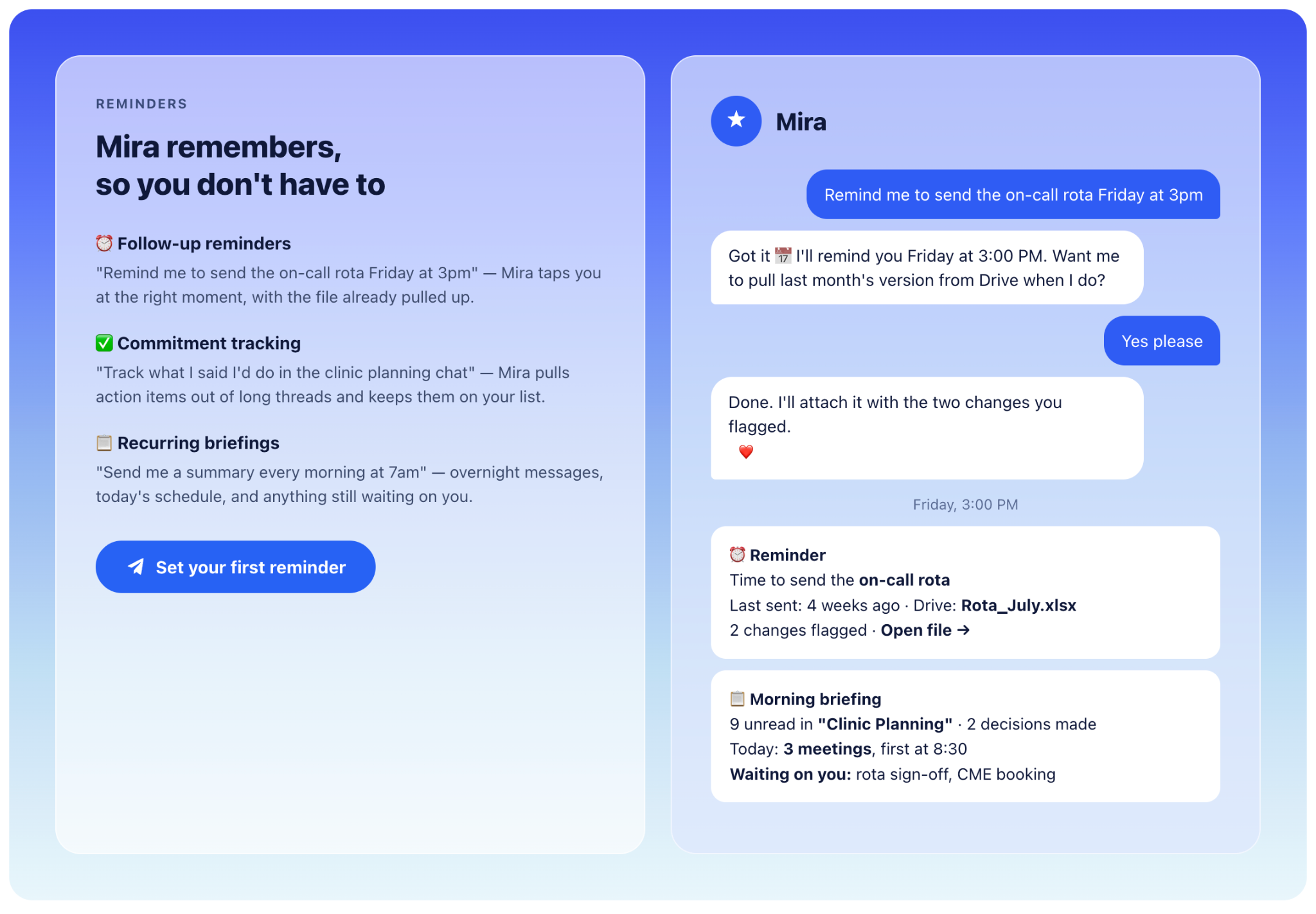
Say what you'd like handled and Mira does it: drafts and sends non-clinical emails, manages your own calendar and reminders, summarizes a research paper or a long group chat thread, tracks follow-ups, and connects to tools like Gmail, Google Calendar, and Notion so you're not switching apps to get any of it done.
Mira works the same way in a group chat, which makes it useful for care-team coordination that doesn't involve protected health information: assigning follow-ups, summarizing a planning thread, keeping a shared to-do list current.
What Mira replaces is the standalone task manager, the second inbox, and the sticky note — the personal overhead that has nothing to do with a patient record.
What you actually say to the Mira AI assistant looks like a normal request, not a command syntax. A few examples from how healthcare professionals use it day to day:
- "Summarize this journal article in five bullet points." Paste a PDF or link and get the key findings without reading the full paper before rounds.
- "Remind me every Friday until this referral is confirmed." Mira keeps nagging on schedule so a follow-up doesn't quietly drop.
- "Draft a reply to this scheduling email and hold it for my review." Non-clinical correspondence gets a first draft instead of a blank cursor.
- "Catch me up on what I missed in the resident group chat overnight." A 40-message thread becomes a three-line summary.
- "Add a recurring task to review the on-call schedule every Sunday night." Recurring admin runs itself instead of living on a whiteboard.
AI for Healthcare at Home: How Everyday People Can Use Mira
You don't need to be a clinician for AI to be useful around your own healthcare, you just need to keep the AI out of the parts that require a medical license.
Mira doesn't diagnose conditions, recommend treatment, interpret your specific test results, or replace a conversation with your doctor. It won't tell you what a symptom means or whether a result is normal for you. What it can do is handle the logistics and information-gathering around your health, the same way it handles email or scheduling for work:
- Appointment and paperwork tracking: Keep your upcoming appointments, referrals, and insurance follow-ups in one place with reminders, instead of across three apps and a notebook.
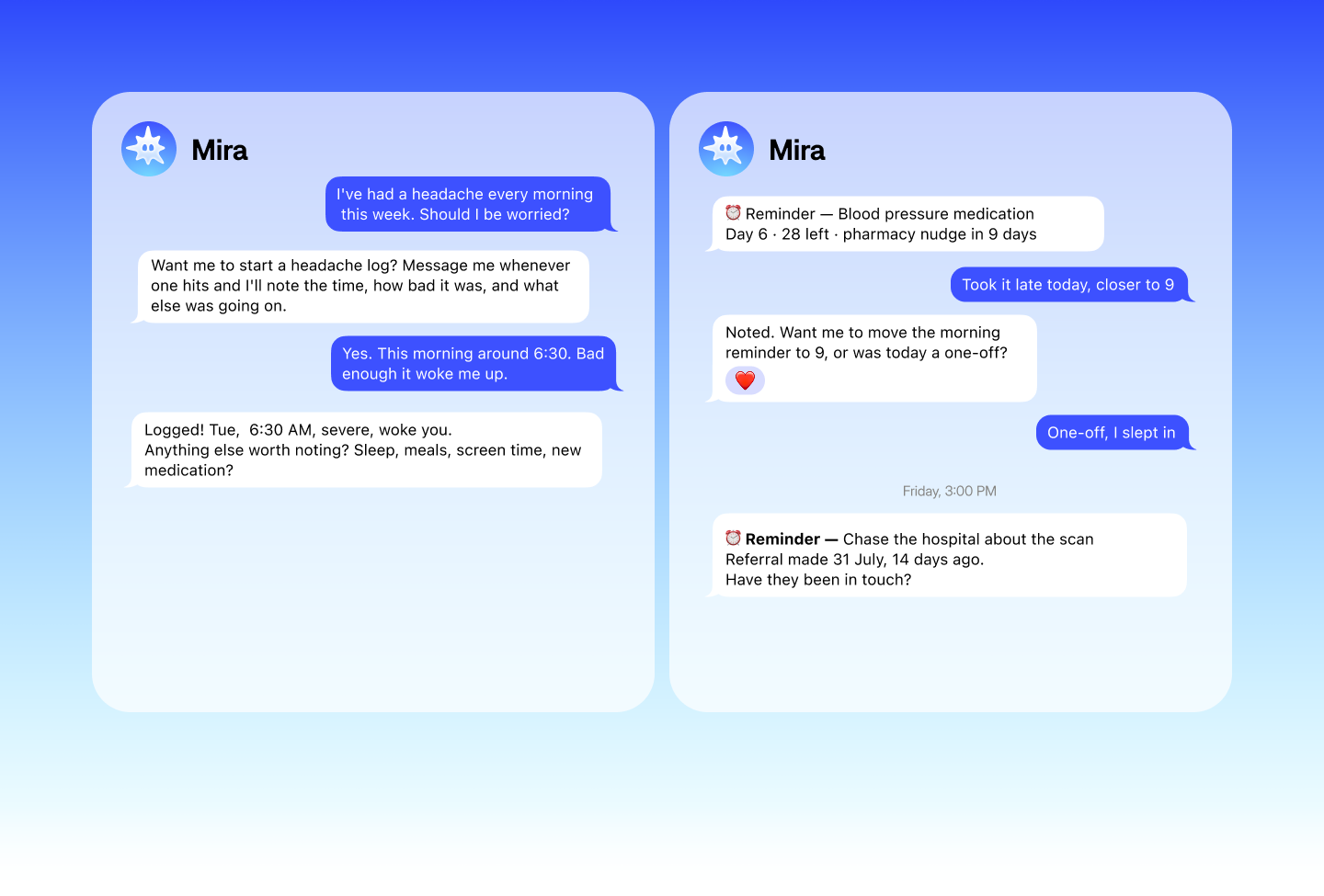
- Medication reminders: Set recurring reminders for prescriptions or supplements so nothing gets missed.
- Plain-language explainers: Ask Mira to explain a medical term or a general concept from a lab report in plain English, useful for walking into your next appointment with better questions, not for deciding what the result means for you.
- Symptom logs for your doctor: Keep a running log of what you've noticed and when, so you show up to an appointment with a timeline instead of trying to remember it on the spot.
- Caregiving coordination: Run a group chat with siblings or family managing a parent's care, tracking who's handling which appointment, medication, or bill.
- General health research summaries: Summarize published, general-audience information on a topic you want to understand better, with the same caveat as any AI-summarized research, verify anything that affects a decision with your doctor.
A few examples of what that actually sounds like:
- "Remind me to take my medication at 8am and 8pm every day." A recurring reminder that doesn't rely on you remembering to set it again tomorrow.
- "What does 'elevated ALT' generally mean?" A plain-language explanation of the term, not a read on your specific result, which is a question for your doctor.
- "Start a log where I can note my headaches this week — time, severity, what I was doing." A running record you can hand to your doctor instead of reconstructing it from memory in the waiting room.
- "Add my mom's cardiologist appointment to the family group chat and remind us all two days before." Caregiving coordination that doesn't rely on one person holding the whole schedule in their head.
- "Remind me to call the insurance company back about this claim on Monday." The follow-up that's easy to mean to do and easy to forget.
One scenario where this adds up: Someone coordinating a parent's care with two siblings in different time zones can run it as a Mira group chat — appointments, medication changes, and who's driving to which visit all land in one thread with reminders attached, instead of scattered across texts.
Try Mira: message @mira on Telegram and ask it to remind you to take your medication, or to start a symptom log before your next appointment. Free to start, nothing to install.
How to Choose the Right AI Tools for Healthcare
Start with what the tool touches, not what it promises. That single question eliminates most of the wrong fits before you sit through a demo.
Any tool that will touch patient data needs a Business Associate Agreement in place first. HIPAA compliant AI tools will have one ready before you ask. If a vendor can't produce a BAA on request, it isn't HIPAA compliant AI, whatever the website claims.