Telegram TON and AI: From Gram to MTONGA and What It Means in 2026
Telegram has always been the default communication layer for crypto. Every major token launch, every DeFi project, every NFT drop - the community lives in Telegram. The trades get discussed there. The alpha gets shared there. The decisions get made there.
But in 2026, something fundamentally changed. Telegram did not just host the conversation about crypto - it took direct control of its own blockchain, launched infrastructure specifically for AI agents, and announced a roadmap that positions TON as the financial and AI execution layer for a billion-plus users.
This is the full story - from the $1.7 billion Gram that the SEC killed, to MTONGA, Agentic Wallets, and the token coming full circle back to the Gram name in June 2026 - and what it all means for AI agents like Mira operating inside Telegram right now.
From Gram to TON: The Story Behind the Blockchain
2018 - The $1.7 billion raise
In 2018, Pavel Durov decided the next layer for Telegram was a blockchain. The Telegram Open Network was supposed to give every user a wallet, a token, and access to decentralized services without leaving the chat app. He raised $1.7 billion in two private presale rounds from 171 investors - one of the largest token sales ever conducted. The token was called Gram.
2019-2020 - The SEC kills Gram
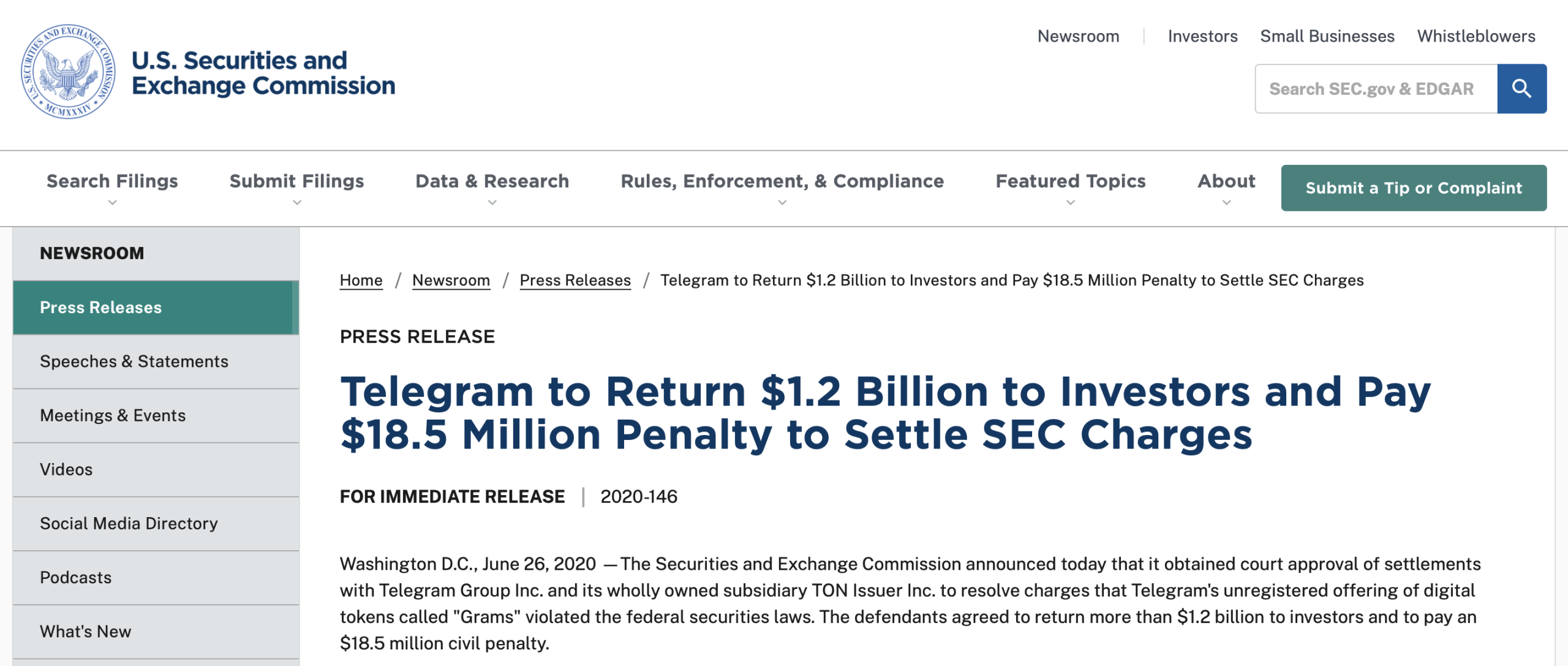
In October 2019, the SEC filed suit arguing that Gram tokens were unregistered securities. A federal court agreed in March 2020 and blocked distribution worldwide. In May 2020, Durov announced the death of the Telegram Open Network.
Telegram paid an $18.5 million fine and returned $1.22 billion to investors. The project he and his brother Nikolai had spent two years and $1.7 billion building was officially over.
Before shutting down, Telegram open-sourced the entire TON codebase and transferred the ton.org domain to the developer community.
2021 - The community relaunches as The Open Network
Developers A. Makosov and K. Emelyanenko picked up the code and launched Newton - a community-driven continuation of the project. In May 2021, Newton was renamed to TON Foundation. The Open Network. The token that was supposed to be Gram became Toncoin.
Telegram was not legally part of it - but the integration points stayed in place from day one. The arms-length distance was a regulatory necessity, not a strategic one.
MTONGA: Make TON Great Again
In May 2026, anyone following Durov's channel started seeing a word they did not recognize: MTONGA. The meaning is simple - Make TON Great Again. The implications are not.
On May 4, 2026, Durov posted: "Fees in TON have dropped 6x - to nearly zero. Next step - Telegram replaces the TON Foundation as the driving force behind TON and becomes its largest validator. The focus shifts to tech superiority. New ton.org, new dev tools, new performance upgrades."
The ton.org website immediately showed: "ton.org is now controlled by MTONGA. Expect changes soon."
What followed:
- Toncoin jumped 36% in 24 hours
- Trading volume spiked 324% to $309 million
- The messaging app forced out of its own blockchain by US securities law six years earlier walked back in through the front door
MTONGA is a seven-step roadmap focused on technical superiority and product integration. Durov did not start with the validator takeover - he started with the technical case. Catchain 2.0 reduced confirmation times significantly, fees dropped 6x, and then came the governance shift. The sequencing was deliberate.
When asked on social media whether "glory days lie ahead," Durov responded: "Inevitable."
Step 4: The Gram Name Returns
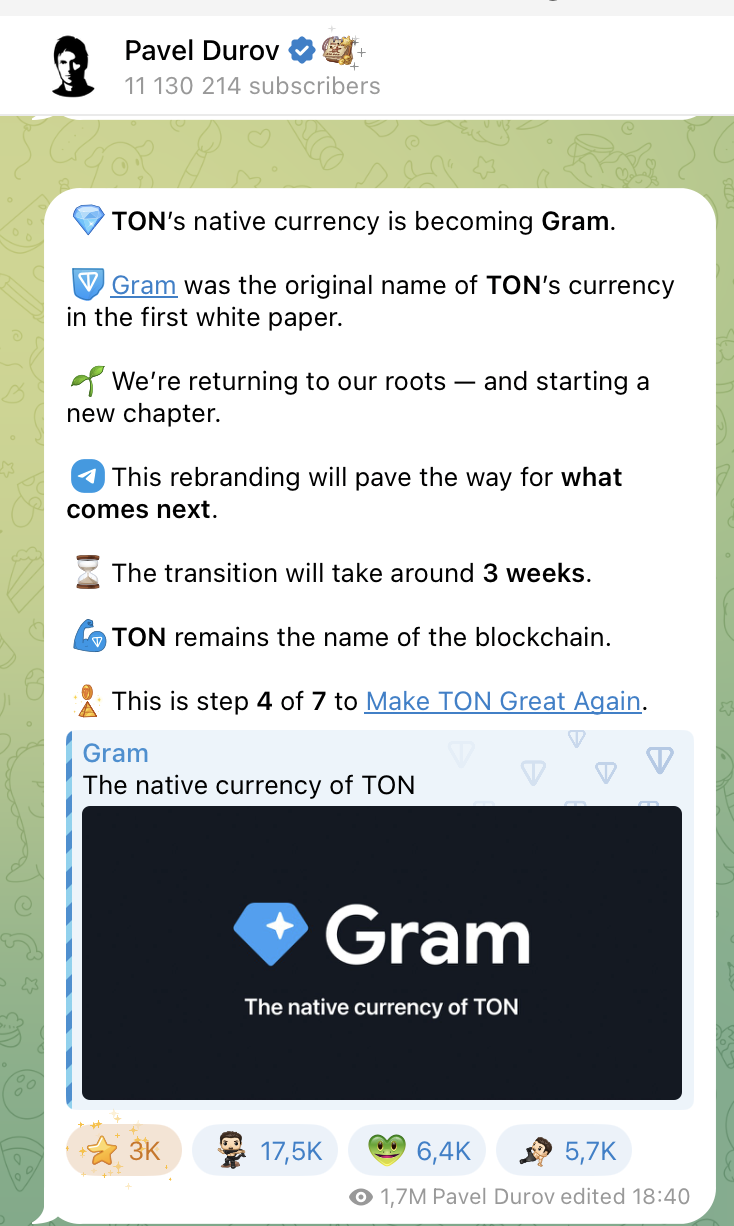
On June 1, 2026 Durov announced step 4 of the MTONGA roadmap: TON's native token is being renamed back to Gram - the original name from the 2018 white paper, the same name the project was forced to abandon after SEC action. The detail that matters: this is a rebrand, not a token swap. The blockchain itself stays TON - only the currency's name and ticker change to Gram, over a roughly three-week transition that requires no action from holders, validators, or DeFi positions. "We are returning to our roots - and starting a new chapter," Pavel Durov wrote.
The TON Ecosystem in 2026: The Numbers
The blockchain that the SEC killed in 2020 has become one of the most active ecosystems in crypto. These numbers are trackable in real time on DefiLlama and CoinMarketCap:
- 54 million wallets activated since inception, with 619,000 daily active wallets
- 4.2 million daily transactions on-chain
- $729 million stablecoin market cap on TON, growing 3.5% weekly
- 611 million TON staked under validation
- $558 million institutional PIPE via TON Strategy Co., backed by Pantera Capital, Kraken, and Blockchain.com
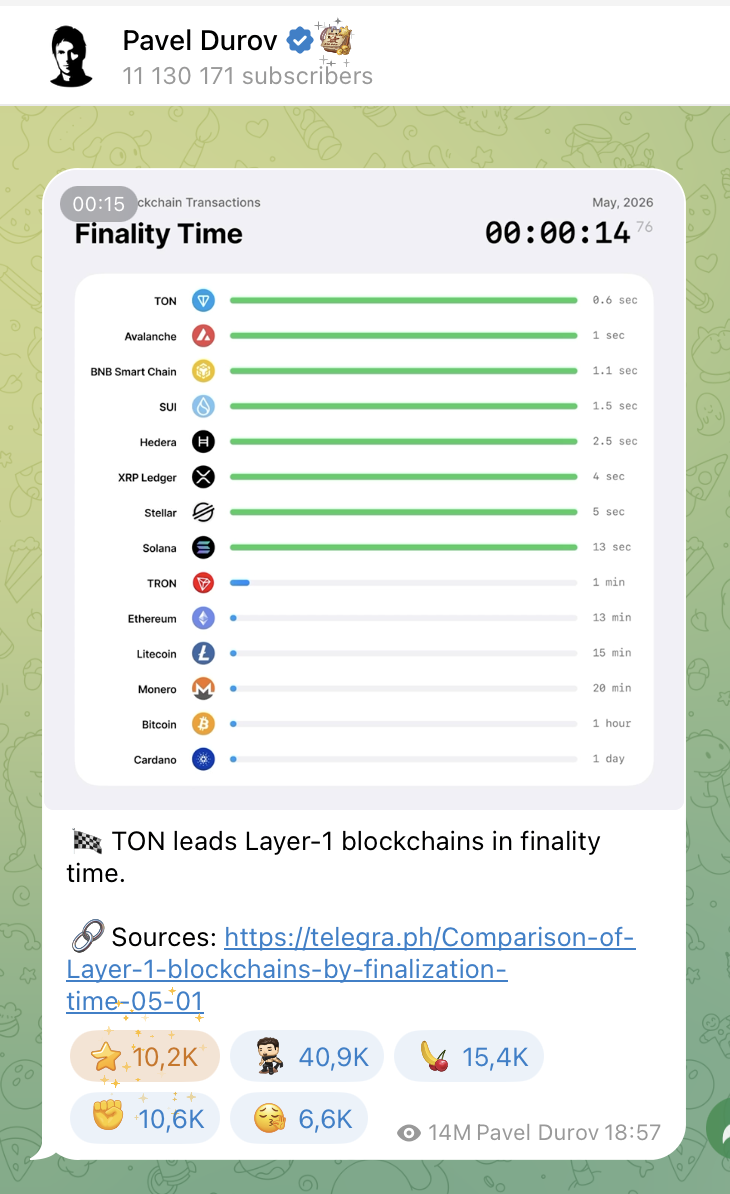
- 0.6-second block time with near-zero fees - purpose-built for high-frequency, low-value flows like payments, tipping, in-app purchases, and bot interactions
The DeFi and wallet layer
The DeFi layer runs primarily through STON.fi - the largest DEX on TON with TVL consistently exceeding $250 million and daily volume reaching $40 million on peak days - alongside DeDust.
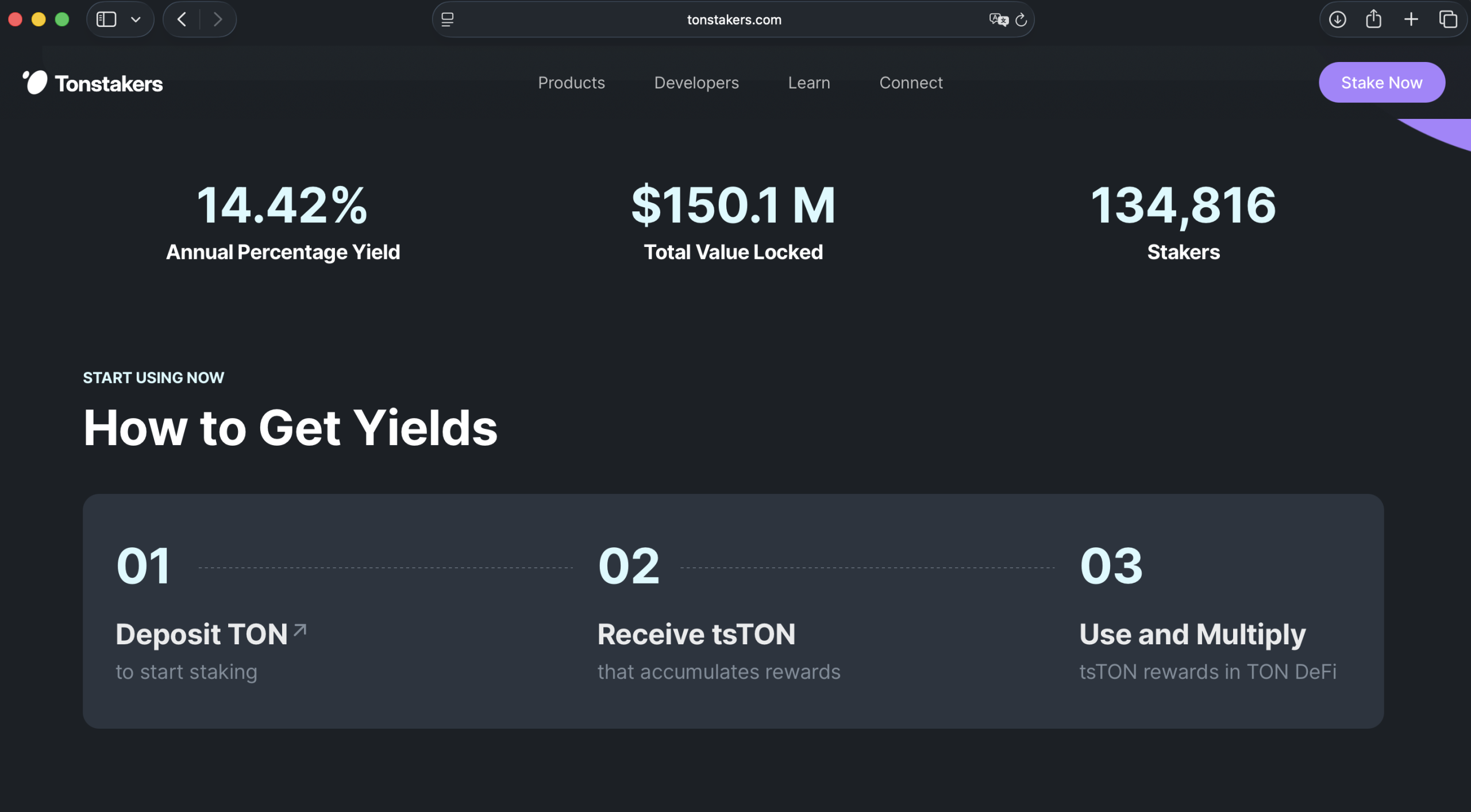
Liquid staking is dominated by Tonstakers, which controls approximately 80% of the TON liquid staking market with over 60 million TON held in liquid staking protocols. The primary user wallet is Tonkeeper, with millions of self-custodial users across the ecosystem.
Agentic Wallets: The Infrastructure Built for AI Agents
Alongside MTONGA, April 2026 brought the most significant technical development for AI agents on TON. TON Tech - the infrastructure team behind The Open Network - launched Agentic Wallets: an open, self-custodial standard that gives AI agents their own dedicated on-chain wallets.
Andrew Grekov, Head of TON Tech, explained it directly: "Agentic Wallets turn AI agents from assistants to actors. Agents on Telegram can not only communicate, but transact - making payments and interacting with on-chain services on behalf of users, without ever touching their keys."
How Agentic Wallets work
Each AI agent gets a dedicated on-chain wallet deployed as a smart contract - technically a Soulbound Token within a shared NFT collection. The mechanics:
- The user funds the wallet with a predefined budget and sets spending limits
- The agent operates within those parameters autonomously, executing transactions at thousands of TPS without requiring per-action user approval
- The user retains ownership through their main Tonkeeper wallet at all times
- The agent holds its own keys but access can be revoked instantly
- No intermediary holds funds at any point
The full technical specification is at docs.ton.org/overview/ai/wallets and the developer infrastructure at agents.ton.org.
What Agentic Wallets enable
- Trading bots with predefined budgets - execute swaps on STON.fi within defined parameters without manual confirmation
- DeFi agents - handle staking on Tonstakers, portfolio rebalancing, and yield optimization autonomously
- Subscription and payment automation - recurring payments, API usage fees, and micro-transactions without user intervention
- Multi-agent deployment - no limit on agents per user, each with its own independent wallet and balance
AgentKit and the Developer Layer
Alongside Agentic Wallets, TON released AgentKit - the developer tooling for building on-chain AI agents. AgentKit handles the smart contract interactions, key management, and transaction execution that would otherwise require significant custom development - the same execution layer that powers how AI agents work inside Telegram.
The technical stack
TON smart contracts are written in two languages:
- FunC - the low-level language that compiles to TVM (TON Virtual Machine) bytecode
- Tact - a higher-level language designed to make TON contract development more accessible
Both are purpose-built for TON's sharded multi-chain architecture capable of processing thousands of transactions per second.
STON.fi's roadmap includes a gRPC-native API optimized specifically for AI-assisted development, launching Q2 2026 - making DEX integration for AI agents significantly more capable and enabling agents to query liquidity, route swaps, and execute trades at the speed autonomous financial operations require.
What This Means in Practice: Use Cases by Role
For crypto traders
Before Agentic Wallets, a trading bot on TON required either custodial key management or constant user confirmation. Now you fund a dedicated agent wallet with a defined budget, set parameters, and the agent executes autonomously within those rules.
A concrete example with Mira: you tell her to monitor your Tonkeeper wallet and execute a DCA purchase of 50 TON worth of a specific token every Tuesday at 10am, provided the price is within a defined range. The agent holds the budget in its own Agentic Wallet, executes the swap on STON.fi each week, and reports back. You set it once. It runs.
For DeFi participants
An AI agent with an Agentic Wallet monitors your positions across STON.fi, Tonstakers, and other TON protocols and acts when conditions warrant:
- Claiming staking rewards automatically
- Rebalancing between protocols when yield differentials exceed defined thresholds
- Voting in governance on proposals you have pre-approved
- Alerting when liquidity conditions change significantly
The full picture of TON DeFi activity is trackable at defillama.com/chain/TON.
For Web3 project teams
Web3 teams building on TON use Telegram as their primary coordination environment. An on-chain AI agent monitors project treasury movements, token holder changes, and smart contract interactions - delivering intelligence to the team group in natural language. Treasury management that currently requires manual oversight can be partially automated within defined parameters.
For NFT collectors and creators
NFT activity on TON - minting events, marketplace listings, floor price movements on Getgems - generates time-sensitive information that benefits from automated monitoring. An agent with an Agentic Wallet can monitor collections and execute purchases when floor prices hit defined thresholds, without requiring you to watch the market in real time.
Where Mira Fits in the TON AI Stack
The TON infrastructure - Agentic Wallets, AgentKit, STON.fi AI API, Telegram's validator position - is the layer that makes autonomous on-chain AI agents possible. Mira is the AI agent that operates on top of that layer inside Telegram.
How Mira connects to the TON stack
Mira runs natively inside Telegram across personal chats and group conversations simultaneously. Her layers connect to TON in specific ways:
- Memory layer - maintains your on-chain context: which wallets you manage, which protocols you use, which addresses you track
- Tool use layer - connects to TON wallet monitoring, transaction execution, smart contract queries, and on-chain event tracking
- Execution layer - as Agentic Wallet infrastructure matures, this expands to include autonomous budget management within parameters you define
The AI Bot Revolution update from Telegram provided the messenger-side infrastructure that makes this possible: persistent bot sessions, group-level context access, and the API surface for agents to act within Telegram at scale.
Why the TON-Telegram-Mira combination is different
The combination is what makes the Telegram AI stack different from every other blockchain making a move toward agentic AI:
- Coinbase launched AgentKit with Agentic Wallets on Base
- Ethereum is developing ERC-8211 for on-chain AI execution
But neither has what TON has: Telegram's billion-plus users already inside the environment where the AI agent operates. The infrastructure and the distribution are the same platform.
The discussion happens in Telegram. The research is handled by Mira. The execution happens on-chain through TON. None of it requires switching to a separate application.
How to Pay for Mira with TON
Mira subscriptions are paid in Telegram Stars - the native payment unit inside Telegram. Stars are not a separate crypto token. They are Telegram's internal currency, used for premium features, bots, and digital goods across the platform.
The connection to TON is in how you acquire Stars. There are four ways to get them:
- Directly inside Telegram - buy Stars through Telegram's native purchase flow using Apple Pay, Google Pay, or card
- By bank card via Tribute - purchase Stars through Tribute, Telegram's monetization platform, using a standard bank card
- TON wallet via Tribute - pay with TON from your Wallet inside Telegram through Tribute - this is the most direct crypto-to-Stars path for TON holders
- TON without KYC via Getgems - purchase Stars using TON through Getgems, the largest NFT marketplace on TON, without identity verification requirements
Why this matters for the TON ecosystem
The Stars payment layer means TON holders can fund AI agent access - including Mira - entirely within the TON ecosystem, without converting to fiat or using traditional payment rails. The Getgems route specifically preserves the pseudonymous nature of crypto payments: no KYC, no bank involved, just TON to Stars to AI agent access.
As TON's Agentic Wallet infrastructure matures, the payment layer for AI agents will become more direct - agents funding their own operational costs from predefined budgets rather than requiring manual subscription management. The Stars system is the bridge between where payments are today and where autonomous agent economics are heading.
From Assistants to Actors
In 2018, Durov raised $1.7 billion to build a blockchain the SEC killed two years later. In 2021, the community rebuilt it under a new name. In 2026, Durov walked back in - as the largest validator, with a seven-step roadmap called Make TON Great Again, and with Agentic Wallet infrastructure that turns AI agents from assistants into actors. And in June 2026, the loop closed completely - the token took back the Gram name the SEC stripped from it six years earlier.
The numbers as of May 2026, according to Tonstat:
- 54,079,645 on-chain activated wallets - growing at 38,501 new wallets per day
- 619,825 daily active wallets, 2.47 million active monthly
- 4,203,710 transactions per day
- 110,870,053 TON locked in liquid staking across all protocols
- 410 validators across 34 countries with 611 million TON staked
- 26.2 million NFTs minted on TON
- Telegram as the largest validator
- Agentic Wallets live since April 2026
- Token renamed to Gram - step 4 of MTONGA roadmap, June 2026
The infrastructure is being built deliberately and the timeline is now.
AI in Telegram
Crypto has always lived in Telegram. Now it can also act there. Open @mira - the conversation and the execution are finally in the same place.