



AI in finance and accounting is already moving from experimentation into everyday work, but adoption is moving faster than oversight. Protiviti's Global Finance Trends Survey shows that 47% of large organizations still lack full visibility into which AI tools employees use, while only 40% have a formal AI governance framework. That gap matters especially in finance, where teams work with sensitive data and need to trust where numbers come from.
In this guide, we compare 14 of the best AI tools and agents for finance and accounting in 2026. We look at what each tool is actually good for, how it fits into finance workflows, and which ones offer the reliability, data access, and control finance teams need.
What is AI used for in finance?
AI in finance is used to analyze financial data, automate repetitive accounting work, improve forecasting, detect anomalies, and help finance teams prepare reports and make faster decisions. In practice, it sits between raw financial data and human judgment, handling much of the research, reconciliation, analysis, and documentation that happens before a decision is made.
AI solutions for finance cover seven main jobs, and almost every product on the market is some combination of them.
- Financial reporting and narrative: Drafting the commentary that explains why a number moved, including variance analysis, board summaries, and MD&A.
- Forecasting and planning: Rolling forecasts, scenario models, revenue forecasting, and budget planning built on historical patterns.
- Reconciliation and close: Matching transactions, clearing accounts, and surfacing the exceptions a human actually needs to review.
- Accounts payable and receivable: Reading invoices, coding them to the GL, routing approvals, and following up on collections.
- Compliance and tax: Monitoring requirements, tracking standards changes, and assembling audit-ready documentation.
- Fraud and anomaly detection: Flagging unusual transactions and patterns that may require review.
- Document search: Answering questions across contracts, filings, reports, and PDFs without someone opening them one by one.
What is notably absent is “make the decision.” AI tools for finance compress the work that happens before a decision, which is often most of the work. The judgment stays with the finance team.
Best AI tools for accounting and finance in 2026: comparison table
We scored every tool on six criteria:
- Integration depth: Does it read directly from your ERP and bank feeds, or does someone export a CSV first?
- Audit trail: Can you reconstruct what the AI did, when, and on what evidence?
- Pricing transparency: Published pricing scored higher than "contact sales."
- Autonomy level: Does it suggest, act with approval, or act alone?
- Data residency: Where does your financial data go, and is it used for training?
- Setup time: Days, weeks, or a quarter with a solutions engineer.
Capabilities and pricing below reflect vendor documentation and public reviews as of August 2026. Verify pricing before you buy.
Overview of the best AI agents for finance
The best AI agents for the finance industry share one trait: they own a recurring process end to end, not a single question. Four of the top AI agents for finance are worth your time in 2026.
1. Mira - best AI agent for finance reporting and team coordination
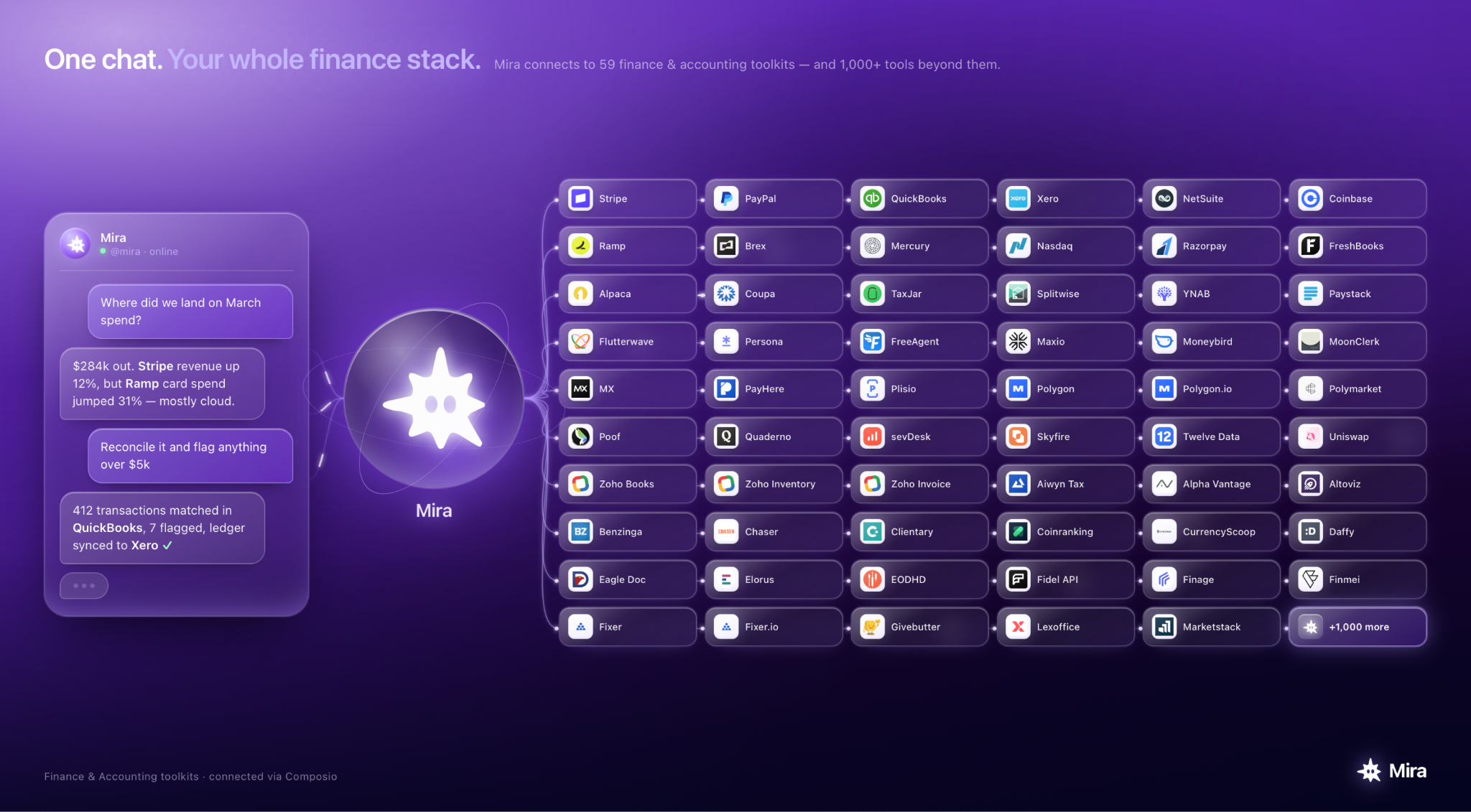
Mira AI agent lives in your messenger and connects to the tools your finance stack already runs on, which makes it the strongest option when the problem is distribution rather than computation.
The mechanism is straightforward. Mira connects to 1,000+ apps, including Stripe, Xero, NetSuite, Brex, Mercury, Freshbooks, so it reads from the systems where your numbers already live. From there it summarizes, schedules, and sends.
- A Stripe revenue digest lands Monday morning without anyone building it.
- A cash-position pull across your banking and accounting tools answers "how much runway do we have" in the same thread where finance already talks.
- Ask it to watch Brex spend, and it flags the category running hot before month-end.
It runs 10+ models (GPT, Claude, DeepSeek, Grok, Kimi, etc.) and routes each task to the one that fits best – a fast model for a summary pull, a stronger one for reasoning.
Most finance AI agents stop at producing an artifact. Mira pushes it to the people who need it and acts on what the conversation decides:
- Approve the budget review, and it books the meeting.
- Sign off on the variance note, and it emails the CFO.
- Flag a discrepancy, and it drops the follow-up task in Notion.
It tracks what was decided and chases the commitments made in the thread. For distributed teams that live in chat, that's the difference between a report that exists and a report that gets read.
Where it stops: Mira is a reporting and coordination layer, not a ledger. It doesn't close your books, doesn't post journal entries, and isn't a system of record. If you need reconciliation or GL coding, you need a dedicated tool.
Pricing: Free tier, Pro plans start from $27/mo.
2. Numeric - best for the month-end close
Numeric is an AI accounting tool for close work because it operates on transaction-level data rather than summaries. It connects to NetSuite, Sage Intacct, QuickBooks Online, and Xero, auto-reconciles accounts, matches cash against thousands of bank connections, and monitors for anomalies as they appear.
Numeric writes the first draft in plain language and the controller edits it.
Pricing: Essentials starts at $30 per user per month, but the Growth and Enterprise tiers most teams actually buy are quote-based, and mid-market deals land between $2,000 and $12,000 monthly depending on entity count and transaction volume. It's a controller's tool, not a small business purchase.
3. Vic.ai - best for accounts payable and receivable
Vic.ai is the clearest example of AI for accounts payable and receivable running without a human in the loop. Autopilot is the part that matters. It routes an invoice from inbox to ERP, automating extraction, GL coding, approval, without human review. It handles PDFs, EDI, email, and handwritten invoices.
Where it stops: Below roughly 1,000 invoices a month, the integration effort outruns the savings, and you're better served by the AP features already inside BILL or Ramp. Pricing is quote-only.
Pricing: Custom, allegedly starting from $25,000 a year.
4. Glean and Hebbia - best AI document platform for finance
Glean and Hebbia are two enterprise tools that solve retrieval, which is the least glamorous and most common finance problem. They index contracts, filings, board decks, and drive folders, then answer questions across all of them with citations back to source.
Use Glean when the corpus is your company's internal systems and the users are everyone. Use Hebbia when the corpus is deep external research (filings, diligence rooms, credit agreements), and the users are analysts who need the reasoning shown.
Pricing: Custom, both tools do not publicly list its pricing.
Best AI tools for financial analysis and reporting
These are the tools you open when you have a question, not a process. Generative AI is better at explaining numbers than producing them, so the strongest workflows keep the math in your ERP, FP&A tool, or spreadsheet and use AI to explain variances, flag anomalies, summarize forecasts, and draft reporting.
The same applies to budgeting: AI is most useful for showing where actuals are drifting from plan and turning those changes into clear commentary.
5. Claude - best AI for finance questions and long documents
Claude is the best AI for finance questions that involve reading, because it handles long documents without losing the thread. Feed it a credit agreement, a 10-K, or a full year of board minutes and ask what changed. It reasons through the detail carefully and tends to say when something is ambiguous rather than inventing a clean answer.
That last trait is why finance teams prefer it. A model that hedges on an unclear covenant is more useful than one that guesses fluently.
Where it stops: no integrations to your ledger, no memory of your business between sessions unless you provide it, and the same arithmetic caveat as every generative model. It's a reading and writing tool.
Pricing: Free tier, paid plans start from $20/mo.
6. ChatGPT - the best free AI tool for finance
ChatGPT's free tier is the most capable of the free AI tools for finance, and it's genuinely sufficient for drafting, summarizing, and one-off analysis. Policy memos, email to a vendor about a disputed invoice, explaining ASC 606 to a founder, turning messy notes into a structured schedule, all fine on the free plan.
Where it stops: the free tier has usage caps and no company data connection. The paid tier adds file handling and connectors. Neither tier is a finance system, and neither should see data you wouldn't email.
Pricing: Free tier, paid plans start from $20/mo.
7. Datarails and Cube - best for FP&A teams that live in spreadsheets
Datarails and Cube both keep Excel as the interface while adding a database underneath, which is the right architecture for FP&A teams who aren't going to abandon their models. Cube also connects Google Sheets and answers natural-language queries through Slack and Teams.
On core FP&A work, like rolling forecasts, scenario comparison, reforecasting, Cube is stronger.
On dashboards and executive-facing visuals, Datarails is better.
Where it stops: be skeptical of the AI layer on both. Datarails markets FP&A Genius for natural-language queries and Cube has added AI-assisted features, but user reports suggest neither has delivered deep automation yet. Buy them for the FP&A architecture; treat the AI as a bonus.
Pricing: Cube's entry tier starts around $1,500 a month; Datarails quotes custom but sits at the affordable end of the FP&A category, well below Anaplan.
8. Tellius and Pigment - best AI-based dashboards for finance teams
Tellius is the strongest option among AI analyst tools for finance teams because it does root-cause decomposition rather than just visualization. You ask why margin dropped, and it decomposes the metric across dimensions to tell you which segment, product, and region drove it.
Pigment is the better choice if planning and reporting need to live in the same model, particularly for multi-entity businesses.
Where they stop: both need a clean semantic layer to work well, which means real implementation time. Neither is a two-week deployment.
Pricing: both tools have custom pricing plans.
Best AI for CFOs and finance directors
For CFOs, the best AI tool is whichever one shortens the distance between a question and a defensible answer, which is almost never the same tool the analysts want. Analysts need depth and control. CFOs need synthesis, speed, and something they can take into a board meeting without re-checking every figure.
That difference points to three specific needs:
- Board-ready narrative: Numeric for close commentary, Tellius for the "why did this move" question, Mira for turning either into prose that survives a board read.
- Cross-entity visibility: Pigment or Cube if you're consolidating multiple entities and the answer depends on which ones are included.
- Conversational access: Conversational AI for finance is the interface most CFOs actually want — asking a question in plain language and getting the number back, without opening a BI tool. Mira does it through messenger with follow-through attached.
The pattern across every CFO deployment that works: the AI drafts, a controller signs off, and the CFO's time goes to the exception rather than the assembly.
AI tools for accountants and bookkeeping
AI tools for accounting are split by company size, and buying across that line is the most common expensive mistake.
Small businesses need AI inside their ledger. Mid-market accounting teams need AI on top of it. That's why lists of the best AI tools for accountants tend to contradict each other.
9. QuickBooks and Xero - best for small-business bookkeeping
For businesses under roughly 50 employees, the best AI for accountants is already inside the accounting platform you use. Both major platforms shipped generative features in late 2025 and both are included rather than sold separately.
QuickBooks runs Intuit Intelligence across the product, categorizing expenses, flagging deductions, drafting invoice reminders, spotting cash flow anomalies, and answering questions in chat.
Xero's assistant is JAX ("Just Ask Xero"), a conversational layer that completes tasks by message, like sending an invoice to a named customer. It's included on every plan at no extra cost and still labeled beta.
The honest comparison: QuickBooks has the stronger AI today, particularly around cash flow forecasting, and it's the safer pick if you're ranking the best AI tools for accounting on capability alone. Xero is cheaper at every tier and doesn't charge per user.
Pricing: QuickBooks plans run from $20 a month for Solopreneur to $275 for Advanced, which carries the deepest AI features and supports 25 users. Xero Early is $25 a month, and Growing is $55 with unlimited users versus QuickBooks Plus at $115 for five.
10. Docyt and Zeni - best for multi-entity and startup back office
Docyt and Zeni take over the back office rather than assisting with it, which makes them the right call when you don't have an in-house bookkeeper and don't want one.
Docyt fits businesses running multiple locations or entities, consolidating bookkeeping, AP, and real-time reporting with AI-driven transaction categorization. Zeni is aimed at startups and pairs AI bookkeeping with human accountants and CFO-level review.
Pricing: Docyt pricing plans start from $299/mo. Zeni plans start from $499/mo billed annually.
11. Trullion - best for lease accounting and revenue recognition
Trullion is the strongest AI accounting tool for standards-heavy work, covering ASC 842, IFRS 16, GASB 87 on the lease side and ASC 606 and IFRS 15 on revenue. Its agentic assistant, Trulli, extracts contract data from PDFs, generates journal entries, reconciles payments, and validates statements against source documents.
The audit angle is the real value. Every extracted figure links back to the source document, which means audit fieldwork stops being a document hunt. It connects to NetSuite and SAP.
Where it stops: narrow by design. If you don't have complex lease or revenue contracts, there's nothing here for you.
Pricing: The company doesn’t publish pricing plans on its website.
12. Anrok - best AI for tax accountants handling sales tax
Anrok is the clearest AI for tax accountants dealing with multi-jurisdiction exposure, monitoring physical and economic nexus in real time across more than 11,000 US jurisdictions, including home-rule cities and 100+ countries.
The problem it solves is one nobody can solve manually. Nexus thresholds change, home-rule cities have their own rules, and a SaaS company selling into 40 states is out of compliance before anyone notices. Anrok watches, calculates, files, and reconciles.
Where it stops: built for software and digital services. If you sell physical goods across complex supply chains, Avalara fits better.
Pricing: The Anrok Starter plan costs $100 per market/month.
Free AI tools for accounting
Free AI tools for accounting are real, and every one of them stops at the same place: none of them touch your ledger. Here's what you actually get without paying.
- Mira, ChatGPT and Claude free tiers: Drafting, explaining standards, summarizing documents, structuring messy data. Genuinely useful, usage-capped, no company data access.
- Bank and card feeds: Every major accounting platform includes machine categorization on its cheapest paid tier. This is the highest-value automation most small businesses will ever get, and it's already in your $25 plan.
- Wave: Free accounting software with automated categorization for very small businesses, monetized through payments and payroll.
What you cannot get free: anything that writes to your books, anything with an audit trail, anything with support when it's wrong. AI tools in accounting that carry real liability are priced accordingly, and that pricing is mostly rational.
AI bookkeeping for small business
AI bookkeeping works for small businesses under one condition: your transaction volume is high enough to be tedious and your transactions are repetitive enough to be learnable. For a 10-person business running 200 to 500 transactions a month, AI categorization and reconciliation saves 10 to 20 hours monthly.
The practical setup for AI for bookkeeping and accounting at this size has three parts.
- Your ledger does the categorization: QuickBooks or Xero learns your patterns from bank and card feeds. This handles the bulk.
- One tool fills the gap your ledger leaves: Usually receipt capture, invoice extraction, or reporting — Dext, Docyt, or the AP features in Ramp.
- A human reviews monthly: A bookkeeper checking AI output takes a fraction of the time of a bookkeeper doing entry.
That last point is where most AI bookkeeping for small business advice goes wrong. AI doesn't remove the reviewer, it just changes what the reviewer does. Categorization accuracy on learned, repetitive transactions runs high. Accuracy on the unusual ones is exactly where it drops, and those are the ones that matter at tax time.
When you still need a human bookkeeper: inventory, multi-entity consolidation, revenue recognition, payroll across states, or anything where a mistake compounds silently for months. AI handles volume. It doesn't handle novelty.
How Mira works for finance professionals
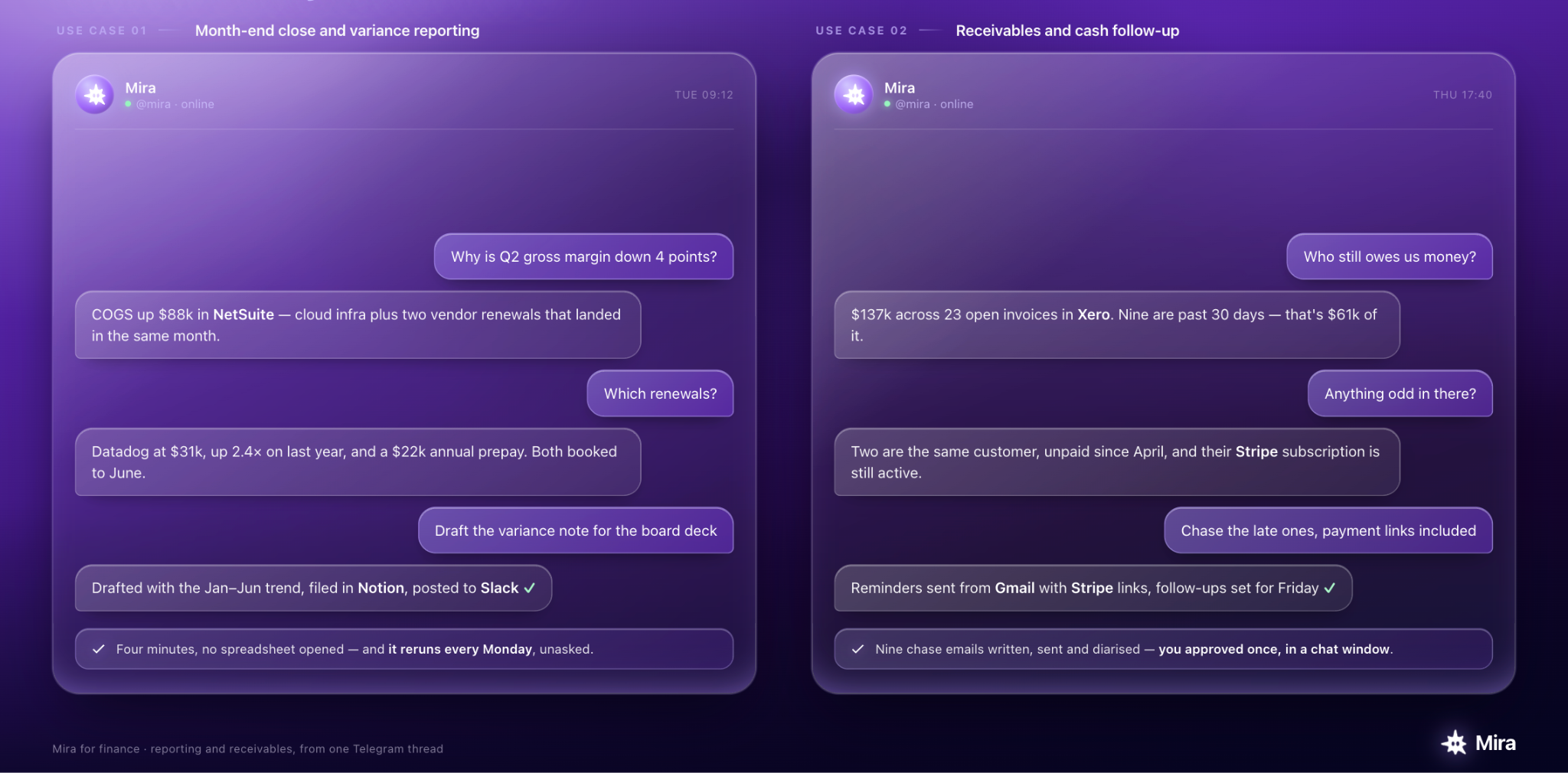
Mira is an AI agent for finance that runs inside a messenger, and it closes one gap: the reporting gets built, then nobody sees it in time.
Numeric closes your books. Cube models your forecast. Neither makes sure Thursday's cash position reaches the four people who need it before Friday's decision.
That's a distribution problem, and it's the one most finance AI still leaves to manual work.
- Connect your stack: Mira reaches 1,000+ apps, including Google Sheets, Notion, and Slack, so it reads from the trackers and systems your reporting already lives in. Setup is a conversation, not an implementation project.
- Ask in plain language: Type the question in a chat you already have open, and the answer comes back in the same thread. No BI login, no dashboard tab, no waiting on an analyst.
- Digests arrive on their own: Tell Mira once you want a Monday cash briefing, and it shows up whether or not anyone remembered to run it. That's the line between a tool and an agent.
- Manage the calendar from the chat: Mira connects to Google Calendar, so it books the close review, blocks the forecast walkthrough, and finds a slot across four calendars without the back-and-forth. You ask in the thread; the invite goes out.
- Follow-ups get captured: Mira sits in group chats, summarizes the thread, and turns decisions into tasks. Finance calls made in chat usually evaporate there. These don't.
There's a free plan and no credit card, so evaluation costs about an afternoon: open Mira at mira.tg, connect one tool, and ask for last week's numbers.