

AI Sales Automation in 2026: Tools, Use Cases and What Actually Work

AI sales automation uses AI to run sales tasks end to end: finding leads, personalizing outreach, scoring and routing prospects, updating the CRM, and adjusting based on what actually gets results. Unlike traditional automation, which sends the same sequence to everyone, AI can adapt messaging, timing, and next steps by prospect, role, and response.
In this guide, we review AI sales automation tools across the stack, from AI agents that work from your messenger to lead generation, outbound, GTM, CRM, and sales intelligence platforms. We also break down the best use cases, what to automate, and practical prompt examples you can use with your sales workflows.
What AI sales automation actually does
AI sales automation takes repetitive work out of the sales process, from prospect research and follow-ups to CRM updates and scheduling. The goal is simple: spend less time on admin and more time talking to qualified buyers.
Most teams use it to solve one of two problems: not enough pipeline or too much manual work behind every deal.
The six core tasks of AI-powered sales automation solutions
These are the areas where AI can remove the most repetitive work from a typical sales workflow.
- Outreach and follow-ups: AI researches prospects, drafts personalized messages, schedules outreach, and follows up automatically when someone goes quiet.
- Lead qualification and scoring: AI lead generation tools compare prospects against your ICP, score intent and fit, route high-priority leads, and help reps focus on the best opportunities first.
- CRM updates and pipeline management: AI captures data from emails, calls, and meetings, updates CRM records, moves deals through stages, and flags stale opportunities without manual data entry.
- Personalized sales sequences: Instead of sending one template to every prospect, AI adapts messaging by role, industry, company, intent signals, and previous interactions.
- Meeting scheduling and follow-through: AI handles scheduling, reminders, meeting prep, summaries, and next steps, removing much of the coordination around sales calls.
- Voice and call automation: AI voice agents can make or receive calls, qualify prospects, answer basic questions, and hand high-intent leads to a human rep.
What AI usually should not own end to end is the part of sales that depends heavily on judgment and human interaction: discovery, complex objections, negotiation, relationship building, and closing strategic deals.
AI sales automation vs. traditional sales automation
The difference is whether the system learns. Traditional automation executes rules you wrote. AI automation writes and rewrites the rules based on outcomes.
The 12 best AI sales automation tools comparison table
We evaluated each tool on five practical criteria: how much it can automate without manual input, whether it updates your CRM, pricing transparency, whether it works for small teams, and how quickly you can get useful results.
We excluded tools that mainly add an AI layer to a traditional dashboard, as well as products with no public pricing or trial. Prices below are starting rates at the time of writing and may change.
Best for AI sales outreach automation
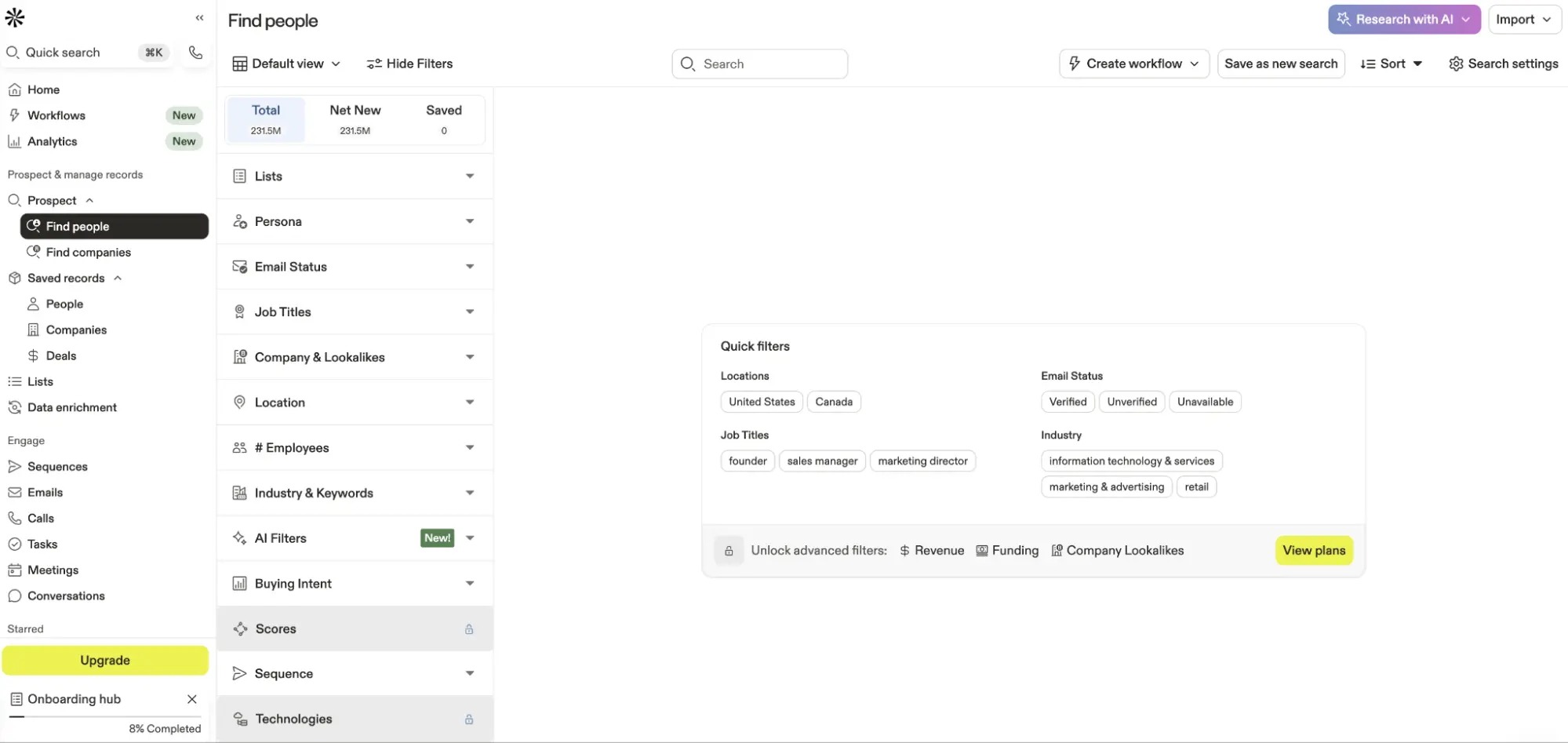
Example of Apollo prospect filtering opportunities
If outbound is the main use case, these three tools fit very different team sizes and workflows:
- Apollo.io — best all-in-one for most sales teams. Combines a B2B contact database, sequencing, dialer, and basic CRM functionality in one platform. A strong default for teams that want prospecting and outreach without stitching together several tools. The trade-off is shallower data than ZoomInfo and fairly average AI writing.
- Lemlist — best for cold email and deliverability. Strong on email warm-up, sending limits, personalization, and multichannel sequences. It does not provide a full prospect database, so most teams pair it with a separate lead source or enrichment tool.
- Outreach — best for larger sales organizations. Built for teams that need standardized cadences, rep governance, analytics, and sales-ops control across a larger organization. It requires more implementation and is generally overkill for small teams.
🟢 Prompt — Cold outreach
Best for AI lead generation automation
These tools cover different parts of lead generation, from enrichment and intent signals to large contact databases:
- Clay — best for enrichment and signal-based prospecting. Clay combines multiple data providers, enriches contacts across sources, and lets you build lead lists around signals like hiring, funding, or tech-stack changes. It is extremely flexible, but the learning curve is steeper than most sales tools.
- ZoomInfo — best for enterprise B2B data. Strong on contact coverage, company data, and buyer-intent signals, particularly for North American B2B teams. The trade-off is enterprise pricing and longer contracts.
- Seamless.AI — best for testing contact discovery on a smaller budget. A simpler way to find verified business contacts without committing to a large data platform. The free credits make it easier to test whether better contact discovery improves your outbound results.
🟢 Prompt — Lead generation
Best CRM with AI sales automation
If you want AI automation built into the system where your pipeline already lives, these are the strongest options:
- HubSpot Sales Hub — best all-in-one CRM for small and mid-sized teams. Combines contact management, deal tracking, email, sequences, lead scoring, forecasting, and automation in one system. The free tier is useful for getting started, while more advanced automation sits behind paid plans.
- Salesforce Sales Cloud — best for complex sales organizations. Highly configurable, built for large teams, and increasingly focused on AI agents through Agentforce. It offers far more flexibility than most CRMs, but setup and implementation are significantly heavier.
- Attio — best modern AI-native CRM. Fast to set up, flexible, and designed around structured data, enrichment, and automation. It is easier to adopt than Salesforce, but still lighter on reporting and enterprise features than more mature CRM platforms.
🟢 Prompt — Lead generation
Best for call intelligence
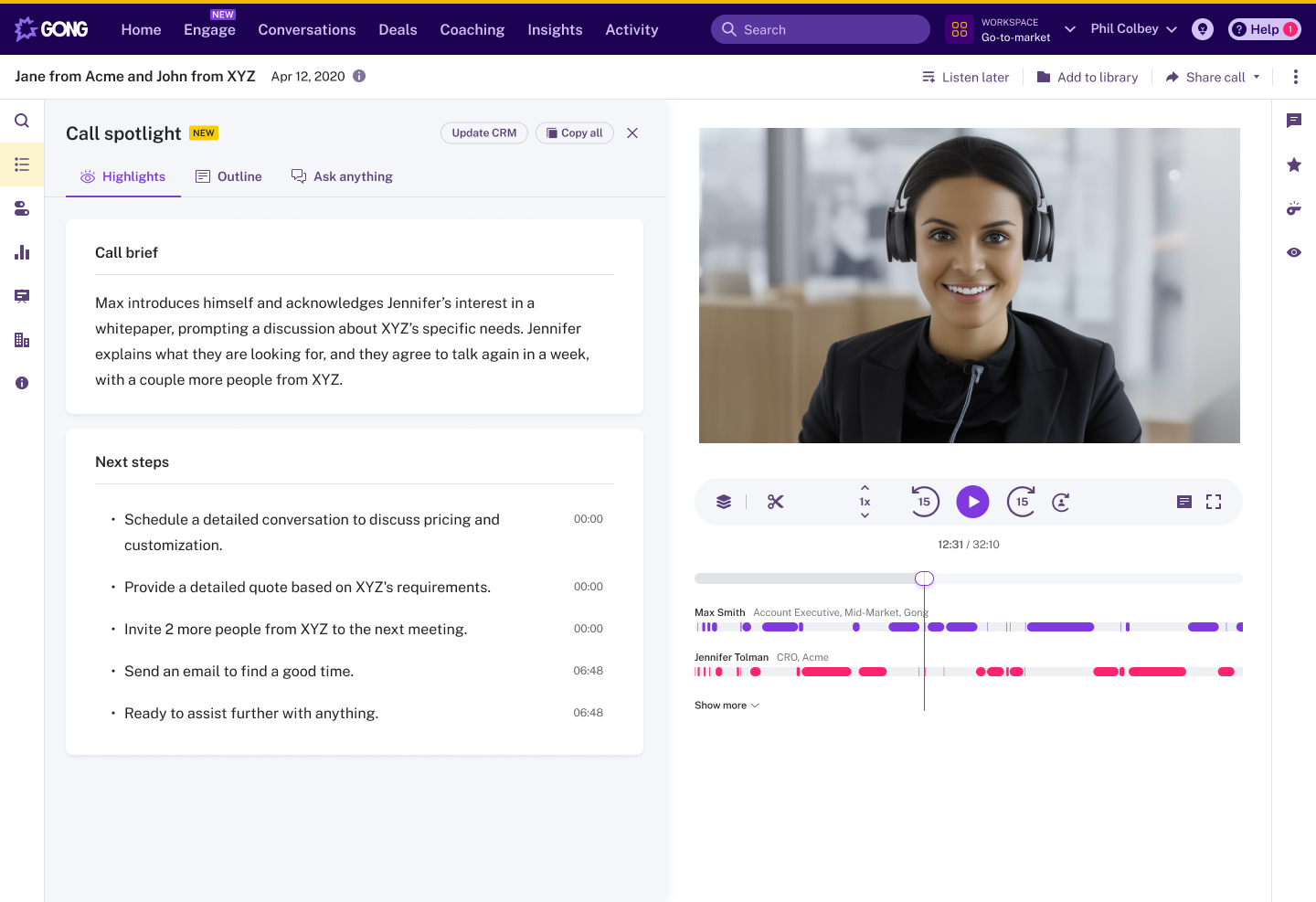
- Gong — best for conversation intelligence and deal visibility. Gong records and analyzes sales calls, surfaces deal risks, flags stalled opportunities, and gives managers data for coaching and pipeline reviews. It is most valuable for larger sales teams with enough call volume to justify the cost and is typically sold on custom pricing.
🟢 Prompt — Lead generation
Top-rated AI sales automation voice agents
For teams using AI to qualify leads by phone, these are the two strongest options to test:
- Retell AI — best for natural, low-latency conversations. Retell runs live outbound and inbound calls, qualifies prospects, and hands high-intent leads to a human rep. Its focus on low latency helps conversations feel less robotic, which matters in real-time sales calls.
- Bland AI — best for high-volume calling. Built for running large outbound campaigns, handling qualification at scale, and routing qualified prospects to sales reps. Pricing is usage-based, typically by call volume or minutes.
Voice agents are most useful for speed-to-lead, basic qualification, appointment booking, and time-zone coverage. They are much weaker at deeper discovery, complex objections, or conversations where the real problem is not obvious from the start.
Automated calling also comes with compliance requirements around consent, disclosure, calling hours, and local regulations. Check the rules that apply to your market before launching outbound campaigns.
🟢 Prompt — Lead generation
Best for running sales workflows from your messenger
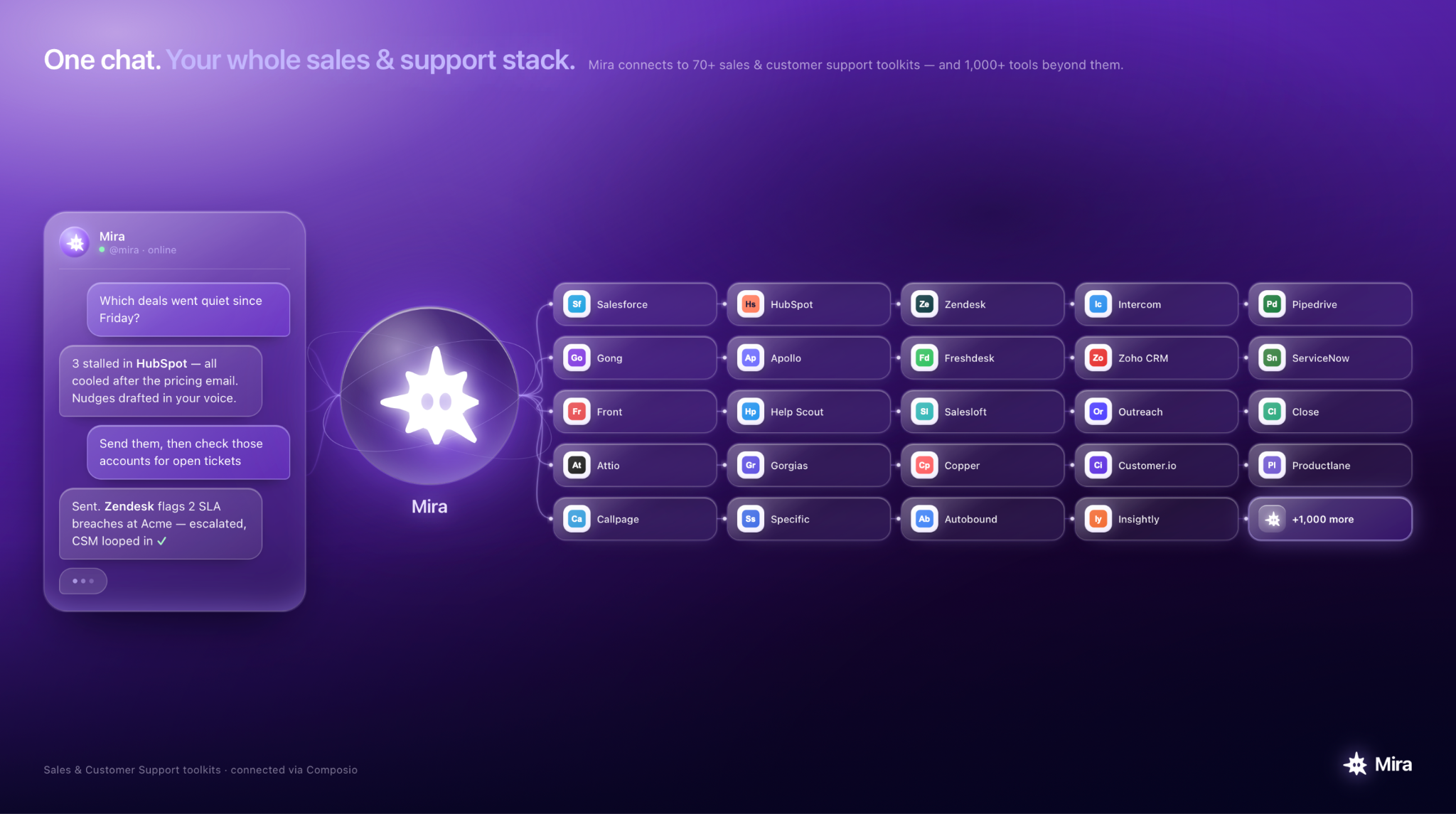
Mira is a personal AI agent that works inside messenger and connects to 1,000+ tools. It is not another sales dashboard. It sits across the tools you already use and can move work between them from a single instruction.
Through its integrations, Mira can work across CRM, prospecting, enrichment, outreach, email, scheduling, proposals, and customer support. For example, it supports workflows such as enriching leads, drafting follow-ups, booking meetings, and preparing call briefs across tools like Salesforce, HubSpot, Gmail, and LinkedIn.
The main difference from most tools in this guide is where the workflow happens. Apollo, Clay, and HubSpot give you a workspace for sales. With Mira, you message the agent like a colleague, and it works across those systems for you.
What it can do for sales
- Lead research and enrichment: Research a company or prospect, pull together relevant context, enrich lead data through connected tools, and add the result to your CRM.
- Prospecting workflows: Work across lead-generation and contact-discovery tools to find prospects, verify contact information, qualify them against your criteria, and prepare them for outreach.
- Personalized outreach: Research the prospect, draft a message using that context, send it through your connected email account, and handle the next follow-up from the same chat.
- CRM execution: Look up deals, update records, add notes, move opportunities forward, and keep HubSpot, Salesforce, and other connected systems current without opening the CRM.
- Pipeline follow-ups: Ask which deals have gone quiet, what still needs a reply, or which commitments are overdue, then have Mira prepare or execute the next step.
- Meeting prep and scheduling: Book discovery calls, manage calendar coordination, and create a pre-call brief from CRM records, emails, notes, and other connected sources.
- Shared deal context: Add Mira to a team chat to summarize long threads, capture decisions and next steps, and keep everyone aligned on what happens next.
- Recurring sales routines: Run jobs such as a daily follow-up list, Monday pipeline brief, stale-deal check, or weekly account summary on a schedule.
🟢 Prompt for @mira
Mira is best for: Founders, solo sellers, and lean GTM teams that want one AI agent to coordinate research, prospecting, outreach, CRM work, follow-ups, and scheduling across their existing sales stack. It is less suited to large sales organizations looking primarily for rep governance, forecasting, and management reporting.
Best free AI sales automation tools
The free tiers worth using are HubSpot, Attio, Apollo, Hunter, Seamless.AI, and Mira. They're genuinely functional, and they all stop working at roughly the same point — volume.
The pattern across all of them: you hit credit and automation limits long before you hit quality limits. Still a free stack is a legitimate way to test whether AI sales automation moves your numbers before you spend anything.
Best AI sales automation for startups
For startups and teams under ten people, the priority is not maximum feature depth. It is getting value quickly without adding another system to manage.
Enterprise sales platforms often assume you have RevOps or sales ops to configure workflows, maintain data, and manage reporting. Early-stage teams usually do not.
A practical sales stack under roughly $300/month:
- HubSpot or Attio — best for CRM. Both are quick to set up and usable without a dedicated sales ops function. HubSpot is the safer all-in-one starting point; Attio is lighter and more flexible.
- Apollo — best for outbound. Combines prospect data, sequencing, email, and dialing in one product, which is usually more useful for a small team than stitching together several specialist tools.
- Mira — best for cross-tool sales execution. Handles research, CRM updates, follow-ups, meeting prep, scheduling, and recurring sales routines from your messenger, so less of the workflow depends on you manually moving information between tools.
Skip Salesforce, Outreach, Gong, and ZoomInfo until the team and sales motion justify them. They are strong products, but their setup, cost, and operational overhead can outweigh the value for a small sales team.
One useful rule at this stage: do not automate a metric you are not already tracking. If you do not know your current reply rate, conversion rate, or sales-cycle length, you will not know whether the new tool is actually helping.
🟢 Prompt — Daily startup sales brief
AI GTM agents with sales automation features
The difference between an AI sales tool and a GTM agent is how much of the workflow it can own. A sequencing tool sends the campaign you configure. An agent can research accounts, identify contacts, personalize outreach, handle follow-ups, book meetings, and update the CRM across several steps.
GTM agents are currently most useful for high-volume, repeatable work such as prospecting, enrichment, inbound qualification, meeting follow-up, and CRM hygiene. They are less reliable when sales depends on complex discovery, negotiation, multiple stakeholders, or high-stakes relationship management.
The main options serve different use cases:
- 11x — best for dedicated AI SDR workflows. Alice focuses on outbound prospecting, while Julian handles inbound qualification and follow-up. Best when you want an agent specifically built around pipeline generation.
- Regie.ai — best for AI-powered prospecting and engagement. Combines prospecting, personalized outreach, sequencing, and rep workflows for teams that want AI embedded directly into outbound execution.
- Salesforce Agentforce — best for Salesforce-native automation. Lets teams build agents around CRM data and workflows, making it most relevant for companies already deeply invested in Salesforce.
- Mira — best for sales workflows that extend beyond sales software. Mira is a general-purpose agent rather than a dedicated AI SDR. It can work across CRM, email, calendars, research, support, docs, and other tools, making it better suited to founders and lean GTM teams whose sales work overlaps with operations, customer support, and other responsibilities.
The safest place to start with GTM agents is work that is high-volume, low-judgment, and easy to review. They can multiply good processes, but they can also multiply bad ones: an agent sending 400 poorly targeted emails creates a much bigger problem than a rep sending four.
🟢 Prompt — End-to-end outbound workflow
How to choose the right AI powered sales automation solution
Pick based on your actual bottleneck, not on feature lists. Find your row:
Where to start
If you're a team with reps and a pipeline, buy Apollo and a CRM, and add Gong when you have enough calls to coach. If you're enriching lists and running signal-based outbound, Clay is worth the learning curve. If you're testing outbound calling, start with Retell on a small list and read the compliance rules first.
And if the honest description of your situation is that sales is one of six things you're doing this week, the fix isn't another dashboard to check. Message Mira and hand it the research, the follow-ups, and the scheduling. Zero setup, no credit card, and you'll know inside a week whether it takes an hour a day off your plate.